ISIS Snuffs Out Ancient Christianity

ISIS Snuffs Out Ancient Christianity
by Raymond Ibrahim  •  November 1, 2014 at 5:00 am

In Egypt, a young Coptic Christian man, accused of blaspheming Islam for simply "liking" an Arabic-language Facebook page, was sentenced to six years in prison.

One of the intruders in Uganda was shouting, "Today we shall kill you [for converting to Christianity] — you… are not respecting our prophet’s religion." He then heard his 12-year-old-girl’s cries as the Muslim intruders were strangling her. Then they seized him.

Muslims in Germany were granted their own section of the cemetery. Now these same Islamic communities are demanding that, during Islamic funerals, Christian symbols and crosses in the cemetery be removed or covered up.
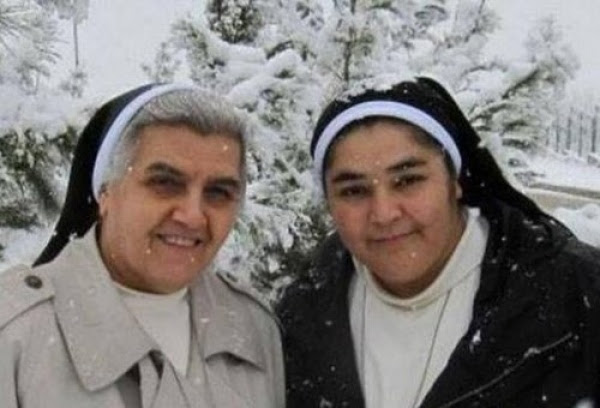
Sister Utoor Joseph (left) and Sister Miskintah, are nuns who disappeared on June 28 in Mosul, Iraq, and are believed to have been kidnapped by Islamists.

During the Islamic State’s June invasion and consolidation of Mosul, Iraq — where Christians have been present since the first century — countless atrocities against them were committed. Accordingly, the region is now reportedly empty of Christian presence.

The Islamic State, among other acts, reinstituted the collection of jizya, the "tribute" conquered Christians (and Jews) were historically required to pay in order not to be killed in accordance with the Koran (9:29).

In one instance, three Islamic State members burst into the home of a Christian family, demanding the jizya-money. When the father of the house pleaded that he did not have the money, the intruders raped his wife and daughter in front of him. The man was reportedly so traumatized that he committed suicide. Four other Christian women were killed for not wearing the Islamic veil.”

Continue Reading Article

From the homily at the canonization of the martyrs of Uganda by Pope Paul VI

From the homily at the canonization of the martyrs of Uganda by Pope Paul VI
The glory of the martyrs—a sign of rebirth

The African martyrs add another page to the martyrology — the Church’s roll of honor — an occasion both of mourning and of joy. This is a page worthy in every way to be added to the annals of that Africa of earlier which we, living in this era and being men of little faith, never expected to be repeated.

In earlier times there occurred those famous deeds, so moving to the spirit, of the martyrs of Scilli, of Carthage, and of that “white robed army” of Utica commemorated by Saint Augustine and Prudentius; of the martyrs of Egypt so highly praised by Saint John Chrysostom, and of the martyrs of the Vandal persecution. Who would have thought that in our days we should have witnessed events as heroic and glorious?

Who could have predicted to the famous African confessors and martyrs such as Cyprian, Felicity, Perpetua and—the greatest of all—Augustine, that we would one day add names so dear to us as Charles Lwanga and Matthias Mulumba Kalemba and their twenty companions? Nor must we forget those members of the Anglican Church who also died for the name of Christ.

These African martyrs herald the dawn of a new age. If only the mind of man might be directed not toward persecutions and religious conflicts but toward a rebirth of Christianity and civilization!
Africa has been washed by the blood of these latest martyrs, the first of this new age (and, God willing, let them be the last, although such a holocaust is precious indeed). Africa is reborn free and independent.

The infamous crime by which these young men were put to death was so unspeakable and so expressive of the times. It shows us clearly that a new people needs a moral foundation, needs new spiritual customs firmly planted, to be handed down to posterity. Symbolically, this crime also reveals that a simple and rough way of life—enriched by many fine human qualities yet enslaved by its own weakness and corruption—must give way to a more civilized life wherein the higher expressions of the mind and better social conditions prevail.