
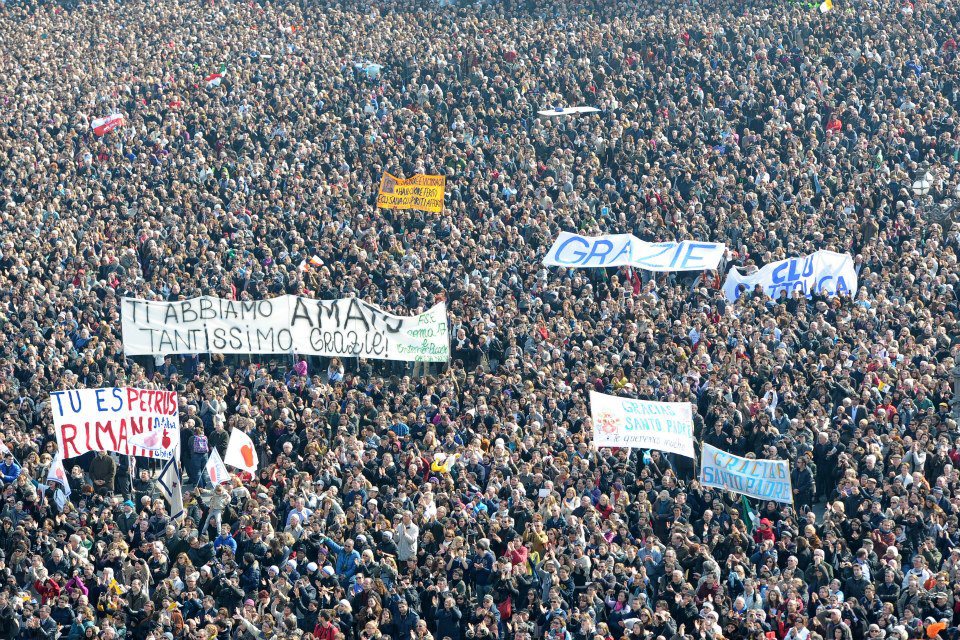
Drawing a crowd at least four or five times its normal size, a throng estimated at well over 100,000 people swarmed St Peter’s Square today for the Pope’s noontime Angelus – the next-to-last Sunday greeting from B16 before his resignation takes effect in 11 days.
Unlike the Wednesday Audience, no tickets are required for the pontiff’s weekly appearance at his study window. It was reported yesterday that the lone remaining mid-week gathering – on the 27th – has already seen 35,000 requests for tickets, and will be moved into the Square from its usual winter venue inside the 7,000-seat Paul VI Hall.
(On-demand video of the gathering is available through the Holy See’s streaming HD player.)
Keeping his usual focus on the day’s Gospel, the departing Popespoke of this First Sunday of Lent’s traditional account of Jesus’ temptation by Satan in the desert.
Quoting his favorite saint – Augustine, the subject of his doctoral dissertation in theology as a young priest, and a figure on whom he’s sought to model himself – Benedict reminded the crowd that “Jesus took our temptations on himself to give us his victory over them.”read more………..
Monthly Archives: February 2013

The War of the Two Councils: The True and the False
by Sandro Magister

In reality, the “little chat” lasted for almost 40 minutes, with the audience very much attentive throughout.
Joseph Ratzinger spoke off the cuff, without ever looking at any notes.
He proceeded according to major chapter divisions, each of them dedicated to the main questions faced one after another by the Council: the liturgy, the Church, revelation, ecumenism, religious freedom, the relationship with Judaism and the other religions.
For each of these themes he said what was at stake and recounted how the conciliar fathers addressed it. With passages of great interest on the concept of the People of God and on the relationship between Scripture and Tradition.
But to everything he added an introduction and a conclusion that particularly impressed those present.
THE INTRODUCTION
Benedict XVI began with an anecdote, telling about when Cardinal Frings had invited him, a young theologian, to write him an outline for a conference that he would have to give in Genoa, at the request of Cardinal Siri, on the topic of “the Council and modern thought.”
The outline pleased the cardinal, who read it just as the young Ratzinger had written it for him. But the best part came afterward:
“A little while later Pope John called Frings, and he was full of trepidation that he may have said something incorrect, something false, and that he had been called upon for a rebuke, perhaps even to have the scarlet taken away.
Among the bishops of the whole world, those who had the most definite intentions from the start were the episcopates of France, Germany, Belgium, Holland, what was called the “Rhenish alliance.” In the first part of the Council “they were therefore the ones who pointed out the way, but the activity was quickly widened and everyone participated more and more in the creativity of the assembly.”” read more…
THE CONCLUSION
At the conclusion of the conversation, Benedict XVI instead subjected to criticism the relationship that has been established between the “true Council” and the “Council of the media,” between the real Council and the virtual one.
Here it is best to consult the literal and complete transcription of his words:
“I would now like to add another point: there was the Council of the fathers – the true Council – but there was also the Council of the media. It was almost a Council unto itself, and the world perceived the Council through these, through the media.
“Therefore the Council that immediately and efficiently arrived to the people was that of the media, not that of the fathers. And while the Council of the fathers was realized within the faith, and was a Council of the faith that seeks ‘intellectus,’ that seeks to understand itself and seeks to understand the signs of God at that moment, that seeks to respond to the challenge of God at that moment and to find in the word of God the word for today and tomorrow, while the whole Council – as I have said – was moving within the faith, as ”fides quaerens intellectum,’ the Council of the journalists was not realized, naturally, within the faith, but within the categories of today’s media, meaning outside of the faith, with a different hermeneutic.
“It was a political hermeneutic. For the media, the Council was a political struggle, a power struggle between different currents in the Church. It was obvious that the media were taking sides with that part which seemed to them to have the most in common with their world. There were those who were seeking the decentralization of the Church, power for the bishops and then, through the expression “people of God,” the power of the people, of the laity. There was this threefold question: the power of the pope, then transferred to the power of the bishops and to the power of all, popular sovereignty. Naturally, for them this was the side to approve of, to promulgate, to favor.
“And so also for the liturgy: the liturgy was not of interest as an act of faith, but as a matter where understandable things are done, a matter of community activity, a profane matter. And we know that there was a tendency, that was also founded historically, to say: sacrality is a pagan thing, perhaps even in the Old Testament, but in the New all that matters is that Christ died outside: that is, outside of the gates, meaning in the profane world. A sacrality therefore to be brought to an end, profanity of worship as well: worship is not worship but an act of the whole, of common participation, and thus also participation as activity.
“These translations, trivializations of the idea of the Council were virulent in the praxis of the application of liturgical reform; they were born in a vision of the Council outside of its proper key, that of faith. And thus also in the question of Scripture: Scripture is a book, historical, to be treated historically and nothing else, and so on.
“We know how this Council of the media was accessible to all. Therefore, this was the dominant, more efficient one, and has created so much calamity, so many problems, really so much misery: seminaries closed, convents closed, liturgy trivialized. . . . And the true Council had difficulty in becoming concrete, in realizing itself; the virtual Council was stronger than the real Council.
“But the real power of the Council was present and, little by little, is realizing itself more and more and becomes the true power that then is also true reform, true renewal of the Church. It seems to me that, fifty years after the Council, we see how this virtual Council is breaking up, is becoming lost, and the true Council is appearing with all of its spiritual power. And it is our task, precisely in this Year of Faith, beginning from this Year of Faith, to work in order that the true Council, with its power of the Holy Spirit, may be realized and that the Church may really be renewed. Let us hope that the Lord may help us. I, retired with my prayer, will always be with you, and together we will go forward with the Lord. In the certainty: the Lord triumphs!”
. . . Yes, when his secretary was dressing him for the audience with the pope he said: ‘Perhaps now I am wearing this robe for the last time.’ Then he went in. Pope John came to meet him, embraced him and said: ‘Thank you, Your Eminence, you have said the things that I wanted to say, but could not find the words.’ In this way the cardinal knew that he was on the right path, and he invited me to go with him to the Council, first as his personal expert and then also as an official peritus.”
Benedict XVI then continued:
“We went to the Council not only with joy, but with enthusiasm. The anticipation was incredible. We were hoping that everything would be renewed, that a new Pentecost would come, a new era of the Church, because the Church was still robust enough at that time, but it seemed more a reality of the past than of the future. And so we were hoping that this would change, that the Church would once again be strength for tomorrow and strength for today.” read more…
Unjust Use of Force, Not Really A Choice | Faith Family and Freedom
Unjust Use of Force, Not Really A Choice | Faith Family and Freedom.
A pregnant 16 year old Texas teen has filed a law suit against her parents claiming they are verbally and physically threatening her to get an abortion. ABC News reported that the Texas Center for Defense of Life filed a lawsuit on her behalf stating that her parents “are violating her federal constitutional rights to carry her child to term by coercing her to have an abortion with both verbal and physical threats and harassment.”
“The Holy Spirit Doesn’t Go on Vacation”
Sunday Snippets–A Catholic Carnival
 It’s time once again for Sunday Snippets. We are Catholic bloggers sharing weekly our best posts with one another. Join us to read and contribute if you like. To participate, go to your blog and create a post titled Sunday Snippets–A Catholic Carnival. Make sure that the post links back to Sunday Snippets–A Catholic Carnival, and leave a link to your snippets post on our host, RAnn’s, site, This, That and the Other Thing. Here are my contributions from the past week:
Lenten Springtime
Lent
Suddenly in Time
Proof of Fasting
No Nobel Prize, BUT Remember THIS WOMAN
Pope Tweeted
Mercy Triumphs! As seen on T.V. « Archdiocese of Washington
Mercy Triumphs! As seen on T.V. « Archdiocese of Washington.
Thus, in the commercial the man considers all Satan’s trinkets against the glories of mercy and he chooses mercy. He know the cost, but considers it acceptable if he can but have mercy for himself, without the Devil as a partner. How about you?
A final detail worth noting in the commercial: At the bottom of the proposed contract held out by Satan is a backward Chi Rho (The Greek abbreviation for “Christ”) and the Latin Inscription Sigilla posuere magister diabolus et daemones (Master seal of the Devil and demons. The backward initials recalls an image of the anti-Christ. And the Latin is more literally means “A seal to set the Devil and demons (as) Master.”
In the end that is the choice. You will have the master your choose. And of this the Lord reminds we must choose one and only one:
No one can serve two masters. Either he will hate the one and love the other, or he will be devoted to the one and despise the other. You cannot serve both God and Money. (Matt 6:24)
Whose coins are in your pocket and whose seal is on them? The choice is yours. You are free to choose, but you are not free NOT to choose. You can have it all now, or store it up bravely for later:
Do not store up for yourselves treasures on earth, where moth and rust destroy, and where thieves break in and steal. But store up for yourselves treasures in heaven, where moth and rust do not destroy, and where thieves do not break in and steal. For where your treasure is, there your heart will be also (Matt 6:19-21)
Why not be Benz (brave) and choose Mercedes (mercy)?
In the end the Scripture is fulfilled for the man which says, Resist the Devil and he will flee (James 4:2)
 Be Holy!