Inspired by a sermon of Monsignor Douglas Raun:

St. Anasthasius
Intrepid defender of the Divinity of Christ
Five times sent into exile
Proclaim the Risen Christ
In season and out of season.

©2011 Joann Nelander

H/T Universalis

From a discourse by Saint Athanasius, bishop

On the Incarnation of the Word

The Word of God, incorporeal, incorruptible and immaterial, entered our world. Yet it was not as if he had been remote from it up to that time. For there is no part of the world that was ever without his presence; together with his Father, he continually filled all things and places.
  Out of his loving-kindness for us he came to us, and we see this in the way he revealed himself openly to us. Taking pity on mankind’s weakness, and moved by our corruption, he could not stand aside and see death have the mastery over us; he did not want creation to perish and his Father’s work in fashioning man to be in vain. He therefore took to himself a body, no different from our own, for he did not wish simply to be in a body or only to be seen.
  If he had wanted simply to be seen, he could indeed have taken another, and nobler, body. Instead, he took our body in its reality.
  Within the Virgin he built himself a temple, that is, a body; he made it his own instrument in which to dwell and to reveal himself. In this way he received from mankind a body like our own, and, since all were subject to the corruption of death, he delivered this body over to death for all, and with supreme love offered it to the Father. He did so to destroy the law of corruption passed against all men, since all died in him. The law, which had spent its force on the body of the Lord, could no longer have any power over his fellowmen. Moreover, this was the way in which the Word was to restore mankind to immortality, after it had fallen into corruption, and summon it back from death to life. He utterly destroyed the power death had against mankind – as fire consumes chaff – by means of the body he had taken and the grace of the resurrection.
  This is the reason why the Word assumed a body that could die, so that this body, sharing in the Word who is above all, might satisfy death’s requirement in place of all. Because of the Word dwelling in that body, it would remain incorruptible, and all would be freed for ever from corruption by the grace of the resurrection.
  In death the Word made a spotless sacrifice and oblation of the body he had taken. by dying for others, he immediately banished death for all mankind.
  In this way the Word of God, who is above all, dedicated and offered his temple, the instrument that was his body, for us all, as he said, and so paid by his own death the debt that was owed. The immortal Son of God, united with all men by likeness of nature, thus fulfilled all justice in restoring mankind to immortality by the promise of the resurrection.
  The corruption of death no longer holds any power over mankind, thanks to the Word, who has come to dwell among them through his one body.

Saint Athanasius (295 – 373)

He was born in Alexandria. He assisted Bishop Alexander at the Council of Nicaea and later succeeded him as bishop. He fought hard against Arianism all his life, undergoing many sufferings and spending a total of 17 years in exile. He wrote outstanding works to explain and defend orthodoxy.
  Athanasius’s passion for the truth seems tactless to many of us today, to the point where some Catholic devotional works even express embarrassment over it. This is grotesque. Before we congratulate ourselves on being more gentle and civilised than Athanasius and his contemporaries, we should look at the lack of charity that characterizes academic controversies today (from string theory to global warming) and the way that some of the participants are willing to use any weapon that comes to hand, from legal persecution to accusations of madness to actual assault. The matters in dispute with the Arians were more important than any of these scientific questions. They were vital to the very nature of Christianity, and, as Cardinal Newman put it, the trouble was that at that time the laity tended to be champions of orthodoxy while their bishops (seduced by closeness to imperial power) tended not to be. The further trouble (adds Chadwick) is that the whole thing became tangled up with matters of power, organization and authority, and with cultural differences between East and West. Athanasius was accused of treason and murder, embezzlement and sacrilege. In the fight against him, any weapon would do.
  Arianism taught that the Son was created by the Father and in no way equal to him. This was in many ways a “purer” and more “spiritual” approach to religion, since it did not force God to undergo the undignified experience of being made of meat. Islam is essentially Arian, granting Jesus a miraculous birth, miracles, a crucifixion and a resurrection, but all as a matter of God demonstrating his power by committing more spectacular miracles than usual.
  Arianism leaves an infinite gap between God and man, and ultimately destroys the Gospel, leaving it either as a fake or as a cruel parody. It leaves the door open to Manichaeism, which mixes Zoroastrian, Buddhist and Gnostic elements into Christianity, so that God is good but creation is bad (or at worst, a mistake) and the work of an evil anti-God. Only by being orthodox and insisting on the identity of the natures of the Father and the Son and the Spirit can we truly understand the goodness of creation and the love of God, and live according to them.
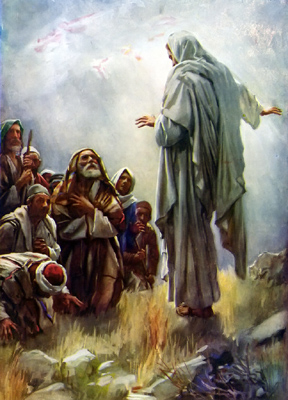
Awakening

Matt 28:20 I Am With You Always

I woke up with God today.
He was with me,
And I smiled.

I am smiling still,
For in His Presence,
I seem to glow,
On the inside, of course.

I hug Christ to me, all gratitude.
Being flighty like a bird,
Anxious to take to wing,
Precisely, because my spirit soars,
I count the grace of moment, a treasure,
and tuck it ‘neath my pinions.

Once aloft on wings of love,
I may be distracted,
Attracted by His good creation,
Or attacked by jealous gods,
Envying His majesty,
And hating His Intimacy
With so lowly a creature.

My God, thank You,
For this favor in Time,
That I may be refreshed,
And readied for Eternity,
Where I shall never
Lose sight of You.

Steel me, O Immanuel.
Sharpen my vision,
To see You with me always,
In Your hidden Presence
Within my soul.

©2011 Joann Nelander  All rights reserved

Throw Away Life?

How sad is Man?
He values the rare,
Exults the extraordinary,
Crowns the celebrity.

God, on the Other hand, proliferates.
He calls good all He creates,
Dignifies life by His Love,
And Humankind by His Incarnation.

For want of goodness,
Man may usurp the place of God,
Seat himself
Upon that lofty throne.

For the want of love
Man may throw life away,
Too small, too young, too needy
Too dependent to matter.

How sad is Man upon his throne?
He beats his chest,
And declares his liberty;
Forgets his neighbor, chooses self.

How sad is Man,
Unencumbered of diety,
His own god,
And lord of all he has stolen.

Yet, God dignifies his defiant creature.
God respects the time of Man,
And give His Goodness
Sway over Holy Wrath.

Out-side of Time.
There is only the Eternal.
In Time, mind and Man are matter-dependent,
Sustained in rhythms tuned by the Creator.

When Time is rolled up
With the stars, like a scroll,
And fire devours all matter,
Where will the spark of Man exist?

While living, Man chooses,
Until Death declares
All he has chosen final,
The Star of Hope extinguished.

O Man, gladden the lot of Men.
Your eternity begins in the Heart of God.
You are rare.
You are extraordinary.

Celebrate the Lord, Your God!

Copyright  Joann Nelander ©2011  All rights reserved.

Empowered

It is not my prayer.
It is our prayer.
I pray with the Church.
I am one among all,
All Yours,
All giving voice
To the Church Militant,

Called by Your Name,
HaShem, the Name!

Empowered by the Name,
HaShem, the Name.

Copyright Joann Nelander © 2011 All rights reserved

The Mystery of Man’s Reconciliation With God

From a letter by Saint Leo the Great, pope:

Lowliness is assured by majesty, weakness by power, mortality by eternity. To pay the debt of our sinful state, a nature that was incapable of suffering was joined to one that could suffer. Thus, in keeping with the healing that we needed, one and the same mediator between God and men, the man Jesus Christ, was able to die in one nature, and unable to die in the other.
He who is true God was therefore born in the complete and perfect nature of a true man, whole in his own nature, whole in ours. By our nature we mean what the Creator had fashioned in us from the beginning, and took to himself in order to restore it.
For in the Saviour there was no trace of what the deceiver introduced and man, being misled, allowed to enter. It does not follow that because he submitted to sharing in our human weakness he therefore shared in our sins.
He took the nature of a servant without stain of sin, enlarging our humanity without diminishing his divinity. He emptied himself; though invisible he made himself visible, though Creator and Lord of all things he chose to be one of us mortal men. Yet this was the condescension of compassion, not the loss of omnipotence. So he who in the nature of God had created man, became in the nature of a servant, man himself.
Thus the Son of God enters this lowly world. He comes down from the throne of heaven, yet does not separate himself from the Father’s glory. He is born in a new condition, by a new birth.
He was born in a new condition, for, invisible in his own nature, he became visible in ours. Beyond our grasp, he chose to come within our grasp. Existing before time began, he began to exist at a moment in time. Lord of the universe, he hid his infinite glory and took the nature of a servant. Incapable of suffering as God, he did not refuse to be a man, capable of suffering. Immortal, he chose to be subject to the laws of death.
He who is true God is also true man. There is no falsehood in this unity as long as the lowliness of man and the pre-eminence of God coexist in mutual relationship.
As God does not change by his condescension, so man is not swallowed up by being exalted. Each nature exercises its own activity, in communion with the other. The Word does what is proper to the Word, the flesh fulfills what is proper to the flesh.
One nature is resplendent with miracles, the other falls victim to injuries. As the Word does not lose equality with the Father’s glory, so the flesh does not leave behind the nature of our race.
One and the same person – this must be said over and over again – is truly the Son of God and truly the son of man. He is God in virtue of the fact that in the beginning was the Word, and the Word was with God, and the Word was God. He is man in virtue of the fact that the Word was made flesh, and dwelt among us.

No Empty Dream

Lamenting, I quit my case.
Sorrowing, my complaints lie with me
In dust and ashes.
The plaintiff  has become defendant.

I rest the case I brought against You.
What have I proven?
That I never knew You?
That I never sought You?

Counterfeits sufficed to fill my belly.
There was always another dream on the horizon.
Tomorrows pretended to satisfy my emptiness.
The chase was the gambit that became the game.

Before You showed me mercy,
You showed me Me
Not the Me of mirrors, but the Me of my heart,
That shrunken pigmy of diminishing proportion.

Among Men, there is no forgiveness like Yours.
If judged by Men, I would be meted punishment
By the self-righteously righteous,
While the unrighteous, would applaud my vice and welcome me at the hearth,
No forgiveness necessary, where sin is no sin.

As gift, the clarity of Day, dawned suddenly,
You appeared with Light as Your garment,
In Your Light I was all Darkness,
Pretense dissipated as Your Sun rose.

The world appeared not as a prize but as a wonder.
Nature didn’t dictate; it served.
The heart of mothers where turned back to their children.
And You reigned as King.

I would have fainted away,
Had not the Good Thief stood by Your side.
He smiled my way,
Eyes twinkling at the memory of his meeting You upon Your Cross.
Assurances asked, assurances given.
Simple eternal words.

Coming full circle, I rest upon Your arm,
You lift up my head and incline to comfort me.
Mercy smiles on my repentant heart,
And plans for me a future full of hope.

You Who laid the foundation of  the Earth,
Plot a course for me through the Wilderness of the world.
My pilgrimage from sin to saint
Leads through Two Hearts bound by a Mystery uniting Heaven and Earth.

Birthed anew in Baptism,
Restored again in Reconciliation,
Your grace acts on me, Your grace acts in me.
All grace that waited upon my willing.

My will is now that of a child.
I follow at Your side, learning Your ways.
Your Words are my food and my fullness.
Heaven is no longer an empty dream, but a Promise.
From You lips on the Cross, piercing my heart.

“Father forgive them.
They know not what they do.”

Copyright Joann Nelander © 2011   All rights reserved.