I Am Not Alone: Christ Is With Me

A letter of Saint Paul Le-Bao-Tinh

I am not alone: Christ is with me

I, Paul, in chains for the name of Christ, wish to re-late to you the trials r me in his praises. The prison here is a true image of everlasting hell: to cruel tortures of every kind – shackles, iron chains, manacles – are added hatred, vengeance, calumnies, obscene speech, quarrels, evil acts, swearing, curses, as well as anguish and grief. But the God who once freed the three children from the fiery furnace is with me always; he has de-livered me from these tribulations and made them sweet,
In the midst of these torments, which usually terrify others, I am, by the grace of God, full of joy and gladness, because I am not alone – Christ is with me.
Our Master bears the whole weight of the cross, leaving me only the tiniest, last bit. He is not a mere onlooker in my struggle, but a contestant and the victor and champion in the whole battle. Therefore upon his head is placed the crown of victory, and his members also share in his glory.
How am I to bear with the spectacle, as each day I see emperors, mandarins, and their retinue blaspheming your holy name, O Lord, Behold, the pagans have trodden your cross underfoot! Where is your glory? As I see all this, I would, in the ardent love I have for you, prefer to be torn limb from limb and to die as a witness to your love.
O Lord, show your power, save me, sustain me, that in my infirmity your power may be shown and may be glorified before the nations; grant that I may not grow weak along the way, and so allow your enemies to hold their heads up in pride.
Beloved brothers, as you hear all these things may you give endless thanks in joy to God, from whom every good proceeds; bless the Lord with me, on his lowly servant and from this day all generations will call me blessed, for to confound the noble. Through my mouth he has confused the philosophers who are disciples of the wise of this world,
I write these things to you in order that your faith and mine may be united. In the midst of this storm I cast 1my anchor toward the throne of God, the anchor that is the lively hope in my heart.
Beloved brothers, for your part put on the and take up as my patron Saint Paul has taught us. than, with all your members intact, to be cast away.
Come to my aid with your prayers, that I may have the strength to fight according to the law, and indeed and to fight until the end and so finish the race. We may not again see each other in this life, but we will have the happiness of seeing each other again in the world to come, when, standing at the throne of the spotless Lamb, we will together join in singing his praises and exult for ever in the joy of our triumph. Amen.
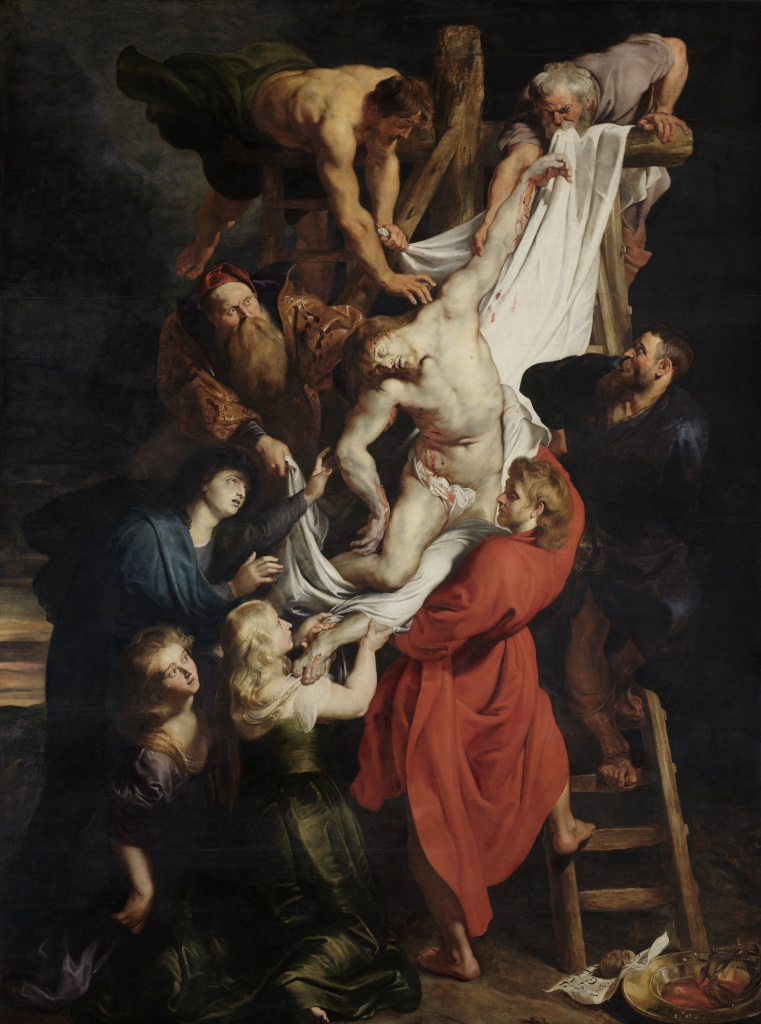
Upon the Cross

Upon the cross,

Your blood flowed

from Crown to Foot,

in streams upon Your Body,

so that there was not one space

that was not touched by Your Blood.

Your Body, the Church,

covered in Your Blood;

saved throughout Time

and for all Time

unto Eternity,

covered by Your Blood.

by Joann Nelander

Martin of Tours – Nov 11

St Martin of Tours

Image by Lawrence OP via Flickr

From a letter by Sulpicius Severus:

Martin the poor and humble man

Martin knew long in advance the time of his death and he told his brethren that it was near. Meanwhile, he found himself obliged to make a visitation of the parish of Candes. The clergy of that church were quarrelling, and he wished to reconcile them. Although he knew that his days on earth were few, he did not refuse to undertake the journey for such a purpose, for he believed that he would bring his virtuous life to a good end if by his efforts peace was restored in the church.

He spent some time in Candes, or rather in its church, where he stayed. Peace was restored, and he was planning to return to his monastery when suddenly he began to lose his strength. He summoned his brethren and told them he was dying. All who heard this were overcome with grief. In their sorrow they cried to him with one voice: “Father, why are you deserting us? Who will care for us when you are gone? Savage wolves will attack your flock, and who will save us from their bite when our shepherd is struck down? We know you long to be with Christ, but your reward is certain and will not be any less for being delayed. You will do better to show pity for us, rather than forsake us.”nnnn

Thereupon he broke into tears, for he was a man in whom the compassion of our Lord was continually revealed. Turning to our Lord, he made this reply to their pleading: “Lord, if your people still need me, I am ready for the task; your will be done.”

Here was a man words cannot describe. Death could not defeat him nor toil dismay him. He was quite without a preference of his own; he neither feared to die nor refused to live. With eyes and hands always raised to heaven he never withdrew his unconquered spirit from prayer. It happened that some priests who had gathered at his bedside suggested that he should give his poor body some relief by lying on his other side. He answered: “Allow me, brothers, to look toward heaven rather than at the earth, so that my spirit may set on the right course when the time comes for me to go on my journey to the Lord.” As he spoke these words, he saw the devil standing near. “Why do you stand there, you bloodthirsty brute?” he cried. “Murderer, you will not have me for your prey. Abraham is welcoming me into his embrace.”

With these words, he gave up his spirit to heaven. Filled with joy, Martin was welcomed by Abraham. Thus he left this life a poor and lowly man and entered heaven rich in God’s favor.

The Living Church is the Body of Christ

Wolframs-Eschenbach. Church of our Lady: Altar...

Image via Wikipedia

A sermon of the second century

The living church is the body of Christ

My name is constantly blasphemed by unbelievers, says the Lord. Woe to the man who causes my name to be blasphemed. Why is the Lord’s name blasphemed? Because we say one thing and do another. When they hear the words of God on our lips, unbelievers are amazed at their beauty and power, but when they see that those words have no effect in our lives, their admiration turns to scorn, and they dismiss such words as myths and fairy tales.

They listen, for example, when we tell them that God has said: It is no credit to you if you love those who love you, but only if you love your enemies, and those who hate you. They are full of admiration at such extraordinary virtue, but when they observe that we not only fail to love people who hate us, but even those who love us, they laugh us to scorn, and the Name is blasphemed.

Therefore, brothers, if we do the will of God the Father, we shall be members of the first spiritual Church that was created before the sun and the moon; but if we fail to do the will of the Lord, we shall be among those to whom it is said in Scripture: My house has been made into a robbers’ den. We must choose then, if we want to be saved, to be members of the Church of life.

You surely cannot be ignorant of the fact that the living Church is the body of Christ; for Scripture says: God made man male and female. Now the male signifies Christ, and the female signifies the Church, which, according to both the Old and New Testament, is no recent creation, but has existed from the beginning. At first the Church was purely spiritual, even as our Jesus was spiritual, but it appeared in the last days to save us.

For the spiritual Church was made manifest in the body of Christ, in order to show us that if we uphold its honour in the outward, visible form, and do not defile it, we shall, through the Holy Spirit, be made its members in the true, spiritual sense. For the body of the Church is a copy of the Spirit, and no one who defaces the copy can have any part in what the copy represents. In other words, brothers, you must preserve the honour of the body in order to share in the Spirit. For if we say that the body is the Church and the Spirit is Christ, it follows that anyone who dishonours his body, dishonours the Church. Such a man will have no part in the Spirit, which is Christ. But if the Holy Spirit is joined to it, this body can receive an immortal life that is wonderful beyond words, for the blessings that God has made ready for his chosen ones surpass all human powers of description.

Medieval Lyrics to Mary the Dawn


Mary the Dawn, Christ the Perfect Day;
Mary the Gate, Christ the Heav’nly Way!
Mary the Root, Christ the Mystic Vine;
Mary the Grape, Christ the Sacred Wine!
Mary the Wheat-sheaf, Christ the Living Bread;
Mary the Rose-Tree, Christ the Rose Blood-red!
Mary the Font, Christ the Cleansing Flood;
Mary the Chalice, Christ the Saving Blood!
Mary the Temple, Christ the Temple’s Lord;
Mary the Shrine, Christ the God adored!
Mary the Beacon, Christ the Haven’s Rest;
Mary the Mirror, Christ the Vision Blest!
Mary the Mother, Christ the Mother’s Son.
Both ever blest while endless ages run.
Amen.

All Will Be Well – All Will Be Well

Secondo Pia's negative of the image on the Shr...

Image via Wikipedia

I’m posting this because I think Theocentric did a good job of summarizing Julian of Norwich‘s “shewings”:

“All Will Be Well”

An Analysis of Julian of Norwich’s “Showings”

In a near-death vision filled with violent and bloody images of suffering, the mystic Julian of Norwich heard God’s assuring words that “all will be well in the end.” In her book, Showings, Julian describes her visions, offering them for the comfort and instruction of God’s people.

Julian’s Visions

As a young woman, Julian prayed for three graces from God: (1) a greater comprehension of Christ’s Passion to increase her knowledge of Jesus; (2) an experience of bodily sickness to the point of death in order to remove her reliance on earthly creatures or comfort, and (3) three wounds to lead her to deeper union with God. (Ch. 1)

God answered her prayers at age 30 when she suffered a bodily illness that brought her to the very brink of death. In this feeble state, she asked to have her upper body elevated so she could contemplate God in her final moments. At this time, the Parson came, accompanied by a boy with a crucifix. As Julian focused on the crucifix, everything around it grew dark. Julian’s pain became so great that she believed she was going to die, when suddenly, all her pain disappeared. Taking advantage of this new turn of events, Julian prayed that God would fill her body with the pains of Christ’s Passion. At this point, her visions began. (Ch. 2 – 3)

In her first revelation, she sees six things: (1) blood trickling down from the crown of thorns on the crucifix before her; (2) a vision of the Virgin Mary; (3) a “spiritual sight” of Christ’s all-embracive love and goodness; (4) a small ball in the palm of Christ’s hand, representing creation, demonstrating its goodness and yet its “smallness” in relation to Christ; (5) three properties in the ball which reveal to her that God is her Creator, lover, and protector; and (6) three “nothings” demonstrating that God is the source of all good and should be sought above all created things. (Ch. 3 – 5)

Next, she has a vision of Christ’s face being battered and bruised. This leads to a revelation that God is present in all things, wisely and providentially working out his purpose. As the body of Christ spews forth blood, Julian sees God’s bountiful provision of forgiveness through Christ’s blood. It is this blood that overcomes the devil and his fiends. Because of God’s overarching providence in all things and Christ’s conquering blood, the devil stands completely defeated in everything he does. This leads Julian to laugh over the devil’s miserable predicament (Ch. 7 – 8).

The laughter leads to a vision of three degrees of bliss in heaven resulting from the joy one experiences upon hearing God’s praise announced publicly in the hearing of all — a joy that once received is everlasting. The vision of bliss is immediately followed by an experience of sorrow and despair. This pattern of bliss and sorrow is repeated again and again, teaching Julian that God loves us and keeps us safe at all times. (Ch. 9)

In the final vision, Julian sees Christ shrivel up in thirst. She cannot imagine a greater pain. The love of Christ demonstrated in his willingness to endure immense pain for the sake of his beloved fills Julian with great joy, so that Jesus becomes “her heaven.” (Ch. 10 – 11)

Suddenly Christ’s appearance becomes joyful and he reveals three heavens to Julian — the joy of the Father, the bliss of the Son, and the endless delight of the Holy Spirit. The three heavens demonstrate God’s infinite delight in his work of salvation. (Ch. 12)

Christ then gives Julian a vision of St. Mary, and in contemplating her bliss and God’s love, Julian realizes that the only thing that hinders her desire for Christ is her own sin, causing her to wonder why God would allow sin in the first place. Jesus replies that “sin is necessary” but that in the end “all will be well.” (Ch. 13)

Julian is disturbed by this revelation. How can all things be well in light of the great harm sin brings? Christ replies that Adam’s sin brought the greatest harm to the world, but now, this harm has been overcome by Christ’s atoning work on the cross. Our lot in life is to embrace the Lord while humbly admitting that some aspects of the Lord’s counsel are closed and hidden to us. (Ch. 14)

Christ concludes by assuring Julian he can and will make all things well in the end. This truth will one day satisfy Christ’s spiritual thirst, when he possesses us wholly as his own. Even though we can’t comprehend this fully now, it is God’s will that we should be confident that “all will be well.” (Ch. 15 – 16)