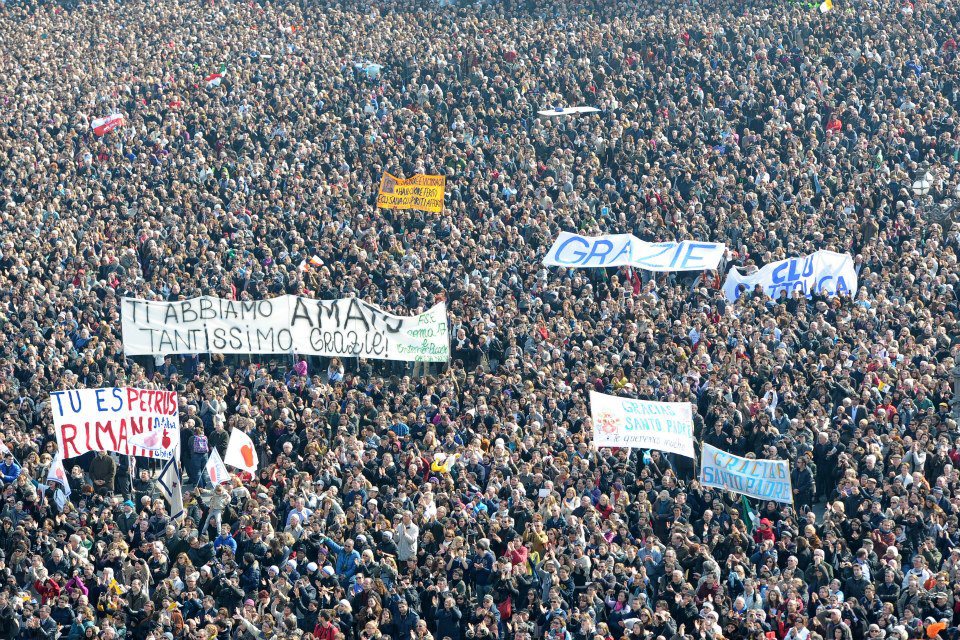
Pope Benedict XVI -His Final Sunday Blessing in St. Peter’s Square:

From the pastoral constitution on the Church in the modern world of the Second Vatican Council

From the pastoral constitution on the Church in the modern world of the Second Vatican Council

Man’s deeper questionings

The world of today reveals itself as at once powerful and weak, capable of achieving the best or the worst. There lies open before it the way to freedom or slavery, progress or regression, brotherhood or hatred. In addition, man is becoming aware that it is for himself to give the right direction to forces that he himself has awakened, forces that can be his master or his servant. He therefore puts questions to himself.

The tensions disturbing the world of today are in fact related to a more fundamental tension rooted in the human heart. In man himself many elements are in conflict with each other. On one side, he has experience of his many limitations as a creature. On the other, he knows that there is no limit to his aspirations, and that he is called to a higher kind of life.

Many things compete for his attention, but he is always compelled to make a choice among them. and to renounce some. What is more, in his weakness and sinfulness he often does what he does not want to do, and fails to do what he would like to do. In consequence, he suffers from a conflict within himself, and this in turn gives rise to so many great tensions in society.

Very many people, infected as they are with a materialistic way of life, cannot see this dramatic state of affairs in all its clarity, or at least are prevented from giving thought to it because of the unhappiness that they themselves experience.

Many think that they can find peace in the different philosophies that are proposed.

Some look for complete and genuine liberation for man from man’s efforts alone. They are convinced that the coming kingdom of man on earth will satisfy all the desires of his heart.

There are those who despair of finding any meaning in life: they commend the boldness of those who deny all significance to human existence in itself, and seek to impose a total meaning on it only from within themselves.

But in the face of the way the world is developing today, there is an ever increasing number of people who are asking the most fundamental questions or are seeing them with a keener awareness: What is man? What is the meaning of pain, of evil, of death, which still persist in spite of such great progress? What is the use of those successes, achieved at such a cost? What can man contribute to society, what can he expect from society? What will come after this life on earth?

The Church believes that Christ died and rose for all, and can give man light and strength through his Spirit to fulfill his highest calling; his is the only name under heaven in which men can be saved.

So too the Church believes that the center and goal of all human history is found in her Lord and Master.

The Church also affirms that underlying all changes there are many things that do not change; they have their ultimate foundation in Christ, who is the same yesterday, today and for ever.


Father Fessio’s Pope Benedict | Daily News | NCRegister.com

Father Fessio’s

A Way With Words


Father Fessio soon learned that the same luminous clarity enlivened Father Ratzinger’s published works.

“Back in 1968, when he published the Introduction to Christianity, the prose was already there,” said Father Fessio, referring to a work that remains a key textbook for graduate theological studies.

When the Catechism of the Catholic Church was completed in 1992, during the pontificate of Blessed John Paul II, Father Fessio reviewed the text and immediately noticed that it bore signs of Joseph Ratzinger’s distinctive ability to synthesize challenging material. At the time, then-Cardinal Ratzinger was the president of the catechism’s Preparatory Commission, which worked for six years to complete the project.

“When I first received the Catechism, I spent a whole retreat meditating on the Table of Contents — it was so beautiful. The Catechism wasn’t just a summary or a book of lists, it presented the faith as an organic whole,” said Father Fessio.

After his mentor was elected pope, Catholics across the globe had their first taste of Benedict’s literary gifts.

“Love is possible, and we are able to practice it because we are created in the image of God. To experience love and in this way to cause the light of God to enter into the world — this is the invitation I would like to extend with the present encyclical,” wrote Pope Benedict XVI in Deus Caritas Est, his first encyclical.

“He is like a painter using his palette to produce a portrait,” said Father Fessio, noting that the Pope also managed to work his magic in collaborative synodal documents as well as his encyclicals.

“He uses simple images — light and dark. You notice the same thing when you open up The Lord of the Rings and begin reading a paragraph: The majority of words are one syllable, and they convey profound thoughts and emotions.”

Thus, when Pope Benedict was enthroned in 2005, “he talked about the pallium, and, when he spoke to the cardinals, he noted that red is for martyrdom.”

Same Man, Different Settings

Over the course of more than 40 years, Father Fessio has stayed in touch with his former professor, meeting with other students from Regensburg for annual gatherings and collaborating on a variety of projects. During that time, the priest said, he has witnessed very little change in the man who will resign from the Petrine office on Feb. 28.

“He was always a theologian of the Church,” he said. “I saw the same man doing the same thing in different settings. He is a faithful servant, and Blessed John Paul II relied on him a good deal.

“But look how the liturgy changed as soon as Benedict was made pope. Chant was introduced. It means that he was not in favor of the kind of liturgies that Pope John Paul II celebrated, but he accepted it. And when he was pope, he acted differently.”

Indeed, while media commentators still dredge up Cardinal Ratzinger’s nickname of “God’s Rottweiler” from his days as prefect of the Congregation for the Doctrine of the Faith, Father Fessio has “never heard him raise his voice. He was always a listener, even at the CDF.”

“I wouldn’t call him shy; I would call him reserved. He is not someone who would enjoy a cocktail party,” said Father Fessio.

“Yes, he is firm. He has tremendous confidence because he has confidence in Christ. Friendship in Christ: It is the bass note in all his work.”

The resulting spiritual serenity sustained him amid the tumultuous decades following the Second Vatican Council, when the German cardinal sparked animosity by insisting that the Council did not constitute a break with the continuity of Catholic Tradition.

Father Fessio recalled a remark the Pope made during a meeting some time after his election.

Another Catholic publisher asked the Holy Father why only Ignatius Press was publishing his works. Father Fessio recalled  that the Pope calmly responded, “Because when no one else cared, they published my works.’”

When Father Fessio learned that the Pope would resign during Lent, he quickly grasped the significance of his timing.

“He was born during Holy Week,” he said. “And I am confident he chose the time for his resignation because he wanted the next pope as an ‘Easter’ pope, with time for reflection.”

Added Father Fessio, “His life begins and ends with the Paschal mystery.”

Joan Frawley Desmond is the Register’s senior editor.


Read more: Pope Benedict | Daily News | NCRegister.com.

Will Benedict Still Be ‘Pope’? | Daily News | NCRegister.com

Will Benedict Still Be ‘Pope’? | Daily News | NCRegister.com.

In his letter, Pope Benedict announced that he would step down from “the ministry of Bishop of Rome, Successor of St. Peter, entrusted to me by the cardinals on April 19, 2005, in such a way, that as from Feb. 28, 2013, at 20:00 hours, the See of Rome, the See of St. Peter, will be vacant and a conclave to elect the new Supreme Pontiff …”

The Pope signed his letter of resignation “BENEDICTUS PP. XVI,” and Bishop Paprocki noted that it “simply means that he is the sixteenth pope by the name ‘Benedict.’ That is a historical fact that will never change.”

Term of Endearment

Bishop Paprocki then suggested that Catholics should view the word “pope” as “an honorific, even a term of endearment (‘papa’ in Italian). It is not the title of an ecclesiastical office.”

Thus, just as Catholics continue to call a priest “Father,” even though “he has resigned from the office of pastor,” so Italians probably “will continue to call Pope Benedict Papa Benedetto even after he leaves office as the Bishop of Rome,” predicted the bishop, who lived in Rome for three and a half years while studying canon law.

“I don’t think people will have a hard time wrapping their minds around having a pope who is no longer the Roman pontiff, bishop of Rome, etc. Certainly, in direct address, one would never address him as anything but ‘Your Holiness.’”

That said, Bishop Paprocki added that it “would be best to know what Pope Benedict himself wants to be called after February 28, and I hope he will tell us.”

While some experts have said that the Pope should be called “Cardinal Ratzinger” after he formally resigns, Bishop Paprocki did not think term seemed “correct.”

“If he had resigned before reaching the age of 80, after which a cardinal may no longer vote in a papal conclave, I do not think he would have, should have or could have donned a red cassock and entered the conclave in the Sistine Chapel to vote for his successor.

“Instead, at 8pm Rome time on Feb. 28, 2013, Pope Benedict XVI will have a new identity to which we will have to become accustomed: His Holiness, Joseph Ratzinger, Pope Benedict XVI, former Roman/supreme pontiff, bishop emeritus of Rome.”

Read more: National Catholic Register

A spotlight on ‘the most interesting man in the church’ | National Catholic Reporter

A spotlight on ‘the most interesting man in the church’ | National Catholic Reporter.

While working on his doctorate at the Pontifical Biblical Institute, Ravasi spent time in Turkey, Iraq, Syria and Jordan on archeological digs, and later served as prefect of the prestigious Ambrosian Library in Milan. Among those who know Ravasi, his penchant for literary allusion is legendary; rarely can he talk for more than five minutes without citing wildly diverse sources such as St. Augustine, Isaac Newton, Vladimir Nabakov, and the Russian Orthodox liturgy.

Despite his prodigious learning, Ravasi has a strong popular touch. On Friday night in Rome he delivered some reflections on Albert Camus at the Jesuit-run Church of Gesù, which struggled to contain an overflow crowd.

Ravasi was scheduled to lead this week’s retreat, delivering a series of spiritual reflections on the Psalms, long before Benedict announced his historic decision to renounce the papacy. The timing, however, means that Ravasi now has a rare opportunity to make a final impression on the other cardinals of the Roman Curia, who are certain to be among the kingmakers in the impending conclave. Moreover, his words will certainly make the rounds in the form of written summaries and rebroadcasts on Vatican Radio, giving the whole world an indirect week-long look at the man who could be pope.

Whispers in the Loggia: At B16’s Window, A Big “Thank You”… While Behind the Walls, The “Showcase” Begins

Whispers in the Loggia: At B16’s Window, A Big “Thank You”… While Behind the Walls, The “Showcase” Begins.

Drawing a crowd at least four or five times its normal size, a throng estimated at well over 100,000 people swarmed St Peter’s Square today for the Pope’s noontime Angelus – the next-to-last Sunday greeting from B16 before his resignation takes effect in 11 days.

Unlike the Wednesday Audience, no tickets are required for the pontiff’s weekly appearance at his study window. It was reported yesterday that the lone remaining mid-week gathering – on the 27th – has already seen 35,000 requests for tickets, and will be moved into the Square from its usual winter venue inside the 7,000-seat Paul VI Hall.

(On-demand video of the gathering is available through the Holy See’s streaming HD player.)

Keeping his usual focus on the day’s Gospel, the departing Popespoke of this First Sunday of Lent’s traditional account of Jesus’ temptation by Satan in the desert.

Quoting his favorite saint – Augustine, the subject of his doctoral dissertation in theology as a young priest, and a figure on whom he’s sought to model himself – Benedict reminded the crowd that “Jesus took our temptations on himself to give us his victory over them.”read more………..