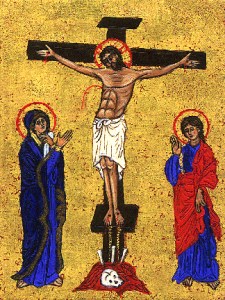
Lenten Reading Plan – Apr 11

crucificionicon12Day40 Church Fathers Lenten Reading Plan 4/11/09

St. Leo the Great: Sermon LXXII (On the Lord’s Resurrection): complete

Day 40Lite Version

St. Leo the Great: Sermon LXXII (On the Lord’s Resurrection): complete

Compilation of Lenten readings

Printer-Friendly Version of Outline: Church Fathers Lenten Reading Plan PDF

The Crucified

H/T  Nice Deb New Revelations about the Shroud of Turin

Divine Mercy Novena – Day 1

Divine Mercy Novena

Day 1

“Today bring to Me all mankind, especially all sinners,

and immerse them in the ocean of My mercy. In this way you will console Me in the bitter grief in to which the loss of souls plunges Me.”

Most Merciful Jesus, whose very nature it is to have compassion on us and to forgive us, do not look upon our sins but upon our trust which we place in Your infinite goodness. Receive us all into the abode of Your Most Compassionate Heart, and never let us escape from It. We beg this of You by Your love which unites You to the Father and the Holy Spirit.

Eternal Father, turn Your merciful gaze upon all mankind and especially upon poor sinners, all enfolded in the Most Compassionate Heart of Jesus. For the sake of His sorrowful Passion show us Your mercy, that we may praise the omnipotence of Your mercy for ever and ever. Amen.

Benedict XVI – Homily -HOLY THURSDAY

From the HOLY THURSDAY – HOMILY OF POPE BENEDICT XVIEVENING MASS OF THE LORD’S SUPPER –BASILICA OF ST JOHN LATERAN – ROME

“Yes indeed, the Eucharist is more than a meal, it is a wedding-feast. And this wedding is rooted in God’s gift of himself even to death. In the words of Jesus at the Last Supper and in the Church’s Canon, the solemn mystery of the wedding is concealed under the expression “novum Testamentum”. This chalice is the new Testament – “the new Covenant in my blood”, as Saint Paul presents the words of Jesus over the chalice in today’s second reading (1 Cor 11:25). The Roman Canon adds: “of the new and everlasting covenant”, in order to express the indissolubility of God’s nuptial bond with humanity. The reason why older translations of the Bible do not say Covenant, but Testament, lies in the fact that this is no mere contract between two parties on the same level, but it brings into play the infinite distance between God and man. What we call the new and the ancient Covenant is not an agreement between two equal parties, but simply the gift of God who bequeaths to us his love – himself. Certainly, through this gift of his love, he transcends all distance and makes us truly his “partners” – the nuptial mystery of love is accomplished.

In order to understand profoundly what is taking place here, we must pay even greater attention to the words of the Bible and their original meaning. Scholars tell us that in those ancient times of which the histories of Israel’s forefathers speak, to “ratify a Covenant” means “to enter with others into a bond based on blood or to welcome the other into one’s own covenant fellowship and thus to enter into a communion of mutual rights and obligations”. In this way, a real, if non-material form of consanguinity is established. The partners become in some way “brothers of the same flesh and the same bones”. The covenant brings about a fellowship that means peace (cf. ThWNT II, 105-137). Can we now form at least an idea of what happened at the hour of the Last Supper, and what has been renewed ever since, whenever we celebrate the Eucharist? God, the living God, establishes a communion of peace with us, or to put it more strongly, he creates “consanguinity” between himself and us. Through the incarnation of Jesus, through the outpouring of his blood, we have been drawn into an utterly real consanguinity with Jesus and thus with God himself. The blood of Jesus is his love, in which divine life and human life have become one. Let us pray to the Lord, that we may come to understand ever more deeply the greatness of this mystery. Let us pray that in our innermost selves its transforming power will increase, so that we truly acquire consanguinity with Jesus, so that we are filled with his peace and grow in communion with one another.”

The entire homily at Whispers in the Loggia


Lenten Reading Plan – Apr 10

crucificionicon12Day39 Church Fathers Lenten Reading Plan 4/10/09

St. Leo the Great: Sermon XLIX(On Lent XI) : complete

Day 39Lite Version

St. Leo the Great: Sermon XLIX (On Lent XI) complete

Compilation of Lenten readings

Printer-Friendly Version of Outline: Church Fathers Lenten Reading Plan PDF

Holy Thursday – Agony

How are we to understand the Agony in the Garden?  Sweating drops of blood is beyond the ordinary experience of the sinner or saint.  Look at those who suffer well for a glimpse into the mystery.

St. Therese of Lisieux experienced her first hemorrhage on Holy Thursday 1896.  In her Story of a Soul we read something of her agony:

For several days, during the month of August, Therese remained, so to speak, beside herself, and implored that prayers might be offered for her. She had never before been seen in this state, and in her inexpressible anguish she kept repeating: “Oh! how necessary it is to pray for the agonising! If one only knew!” One night she entreated the Infirmarian to sprinkle her bed with Holy Water, saying: “I am besieged by the devil. I do not see him, but I feel him; he torments me and holds me with a grip of iron, that I may not find one crumb of comfort; he augments my woes, that I may be driven to despair. . . . And I cannot pray. I can only look at Our Blessed Lady and say: ‘Jesus!’ How needful is that prayer we use at Compline: ‘Procul recedant somnia et noctium phantasmata!’ (‘Free us from the phantoms of the night.’) Something mysterious is happening within me. I am not suffering for myself, but for some other soul, and satan is angry.” The Infirmarian, startled, lighted a blessed candle, and the spirit of darkness fled, never to return; but the sufferer remained to the end in a state of extreme anguish. One day, while she was contemplating the beautiful heavens, some one said to her: “soon your home will be there, beyond the blue sky. How lovingly you gaze at it!” She only smiled, but afterwards she said to the Mother Prioress: “Dear Mother, the Sisters do not realise my sufferings. Just now, when looking at the sky, I merely admired the beauty of the material heaven–the true Heaven seems more than ever closed against me. At first their words troubled me, but an interior voice whispered: ‘Yes, you were looking to Heaven out of love. Since your soul is entirely delivered up to love, all your actions, even the most indifferent, are marked with this divine seal.’ At once I was consoled.”