
The Anchoress gives us Stephen Colbert Defender of Gospels, taking on Bart Ehrman. I don’t know what Pope Benedict would say for the style of his exegesis? It does feel good seeing someone getting a few good punches in there for the Lord. I think, though, of Jesus turning the other cheek. However, my feistier side recalls, Jesus calling out his assailant in John 18: 22-23 when He was struck by the temple guard, saying,”If I have spoken wrongly, testify to the wrong; but if I have spoken rightly, why do you strike me?” But, I digress. I do like Colbert’s agility as an apologist. However, for the sake of reverence, feel on safer ground with Scott Hahn.
Category Archives: Spiritual
Prepared by Repentance -Enabled by Faith
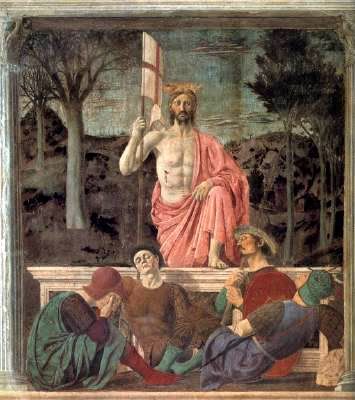 At Easter, we see the Resurrected Lord and are bathed in the Light of His conquering Love. The Church places Jesus before the eyes of our hearts. It is precisely because, only a few days ago, we beheld His pain and suffering, His Love unto Death, that we can grasp the triumph of His Love, this Agape.
Carmel is a reminder that Love must be lived to be authentic. Not that we can live it with perfection, though that is the Call, but that we try day by day in all humility. For me, it is always beginning anew. Repentance prepares us and faith enables us.
The Secular Carmelites share in Meditations from Carnel the words of Pere Jacques:
“We are at Carmel only for this: to love!To love, of course, requires that we give proof of our love. This love expresses itself in constant prayer. I say “constant,” because this state of prayer must be our life not for only two hours a day, but all day long. Our life must be a constant, silent prayer that rises unceasingly to God. That is what constitutes our duty in life.We must not confuse this state of prayer with religious sentimentality, or with pious feelings unrelated to authentic prayer, which can sometimes be piercingly painful. That love, which is our life’s duty, must express itself in vibrant, zealous deeds, all aspects of which compel our careful consideration.Only with deepest humility can we recognize how far we are from our goal. Only those souls who have attained a lofty level of holiness can truly acknowledge how far they still are from their total fulfillment. For example, the Cure of Ars considered himself more wretched than the notorious sinners to whom he ministered. He realized that many of these fallen souls, had they received the same graces that he had received, would perhaps surpass him in holiness. Only with humility can we recognize the torpor of our love.Prayer is our primary duty. Prayer is the reason why God has placed us on earth. We learn truly to prayer, when we are in the presence and company of Christ. Therefore, we must contemplate Christ for long periods of a time and seek him our persistently. Consider those closest to Christ. Saint John the Apostle grasped what was indispensable for a clear understanding of his master. John never tired of probing and querying Christ. We can see how John thus gained richer insights and fuller explanations, precisely because he went to the bother of approaching and asking Christ to clarify each day’s lesson. I picture John, walking close behind Christ, as he made his way about the Holy Land. Thus, John came to gain a wealth of intimate knowledge, which the other apostles did not acquire. Herein lies the explanation for the special character of the fourth Gospel. While the other apostles traveled across the then known world on their missionary journeys, John’s unique apostolate was to remain close to the Virgin Mary, whom Christ had entrusted to him. Thus were these two great souls conjoined in love and prayer”.In silent solitude, let us seek to realize that we truly can be in contact with God. It is God whom we should aim to encounter in prayer. It is God who is both the breath and the fulfillment of our life. Amen.”
Intense Hunger for God – Purgatory
Since these Easter days lead up to Mercy Sunday, I read a little from Divine Mercy in My Soul, St. Faustina’s diary. Here’s what got my attention. It has to do with purgatory.
1185 July 9.1937. This evening, one of the deceased sisters came and asked me for one day of fasting and to offer all my [spiritual] exercises on that day for her. I answered that I would.
1186 From early morning on the following day, I offered everything for her intention. During Holy Mass, I had a brief experience of her torment, I experienced such intense hunger for God that I seemed to be dying of the desire to become united with Him. This lasted only a short time, but I understood what the longing of the souls in purgatory was like.
Praying for the souls in purgatory is, of course, a good work and a good habit, but sometimes I lose track of who they actually are. They can seem a homogenous mass of unknown people, like the “huddled masses yearning to breathe free” on our Statue of Liberty. Who are they to me personally. For me, they are my mother and father, my husband’s mother and father, sister and brother, my aunts, uncles, cousins and friends who have preceded me in death, intimate loved ones awaiting my prayers. Somehow it makes a difference to how I pray and that I pray.
Easter Monday – Celebrate!
Alleluia! Still celebrating Easter. It’s too great for just one day.  When a greeted a friend of mine from Poland this morning with “Happy Easter” she said, “You know in Poland they are still celebrating.” I mentioned the Easter octave and that here we are still celebrating, also. What my friend then explained is that in Poland it is still a holiday, no work, no school. She said she felt bad sending her children off to school today and that she thought Poland’s way is better. Didn’t argue with that.
From the Office of Readings:
1 Peter 1: 1-21
Peter, apostle of Jesus Christ, sends greetings to all those living among foreigners in the Dispersion of Pontus, Galatia, Cappadocia, Asia and Bithynia, who have been chosen, by the provident purpose of God the Father, to be made holy by the Spirit, obedient to Jesus Christ and sprinkled with his blood. Grace and peace be with you more and more.
Blessed be God the Father of our Lord Jesus Christ, who in his great mercy has given us a new birth as his sons, by raising Jesus Christ from the dead, so that we have a sure hope and the promise of an inheritance that can never be spoilt or soiled and never fade away, because it is being kept for you in the heavens. Through your faith, God’s power will guard you until the salvation which has been prepared is revealed at the end of time. This is a cause of great joy for you, even though you may for a short time have to bear being plagued by all sorts of trials; so that, when Jesus Christ is revealed, your faith will have been tested and proved like gold – only it is more precious than gold, which is corruptible even though it bears testing by fire – and then you will have praise and glory and honour. You did not see him, yet you love him; and still without seeing him, you are already filled with a joy so glorious that it cannot be described, because you believe; and you are sure of the end to which your faith looks forward, that is, the salvation of your souls.
It was this salvation that the prophets were looking and searching so hard for; their prophecies were about the grace which was to come to you. The Spirit of Christ which was in them foretold the sufferings of Christ and the glories that would come after them, and they tried to find out at what time and in what circumstances all this was to be expected. It was revealed to them that the news they brought of all the things which have now been announced to you, by those who preached to you the Good News through the Holy Spirit sent from heaven, was for you and not for themselves. Even the angels long to catch a glimpse of these things.
Free your minds, then, of encumbrances; control them, and put your trust in nothing but the grace that will be given you when Jesus Christ is revealed. Do not behave in the way that you liked to before you learnt the truth; make a habit of obedience: be holy in all you do, since it is the Holy One who has called you, and scripture says: Be holy, for I am holy.
If you are acknowledging as your Father one who has no favourites and judges everyone according to what he has done, you must be scrupulously careful as long as you are living away from your home. Remember, the ransom that was paid to free you from the useless way of life your ancestors handed down was not paid in anything corruptible, neither in silver nor gold, but in the precious blood of a lamb without spot or stain, namely Christ; who, though known since before the world was made, has been revealed only in our time, the end of the ages, for your sake. Through him you now have faith in God, who raised him from the dead and gave him glory for that very reason – so that you would have faith and hope in God.(source: Universalis)
Painting With Stars

He is Risen! – Alleluia!
Happy Easter Everyone! Alleluia!
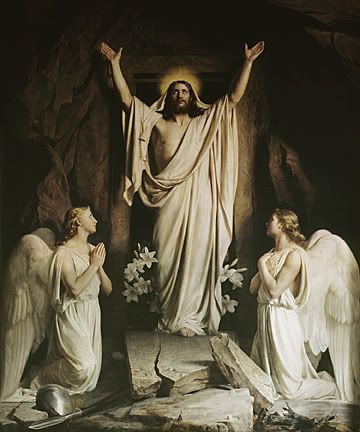
Homily of Pope Benedict XVI – Easter Sunday 2009
“Christ, our Paschal lamb, has been sacrificed!” (1 Cor 5:7). On this day, Saint Paul’s triumphant words ring forth, words that we have just heard in the second reading, taken from his First Letter to the Corinthians. It is a text which originated barely twenty years after the death and resurrection of Jesus, and yet – like many Pauline passages – it already contains, in an impressive synthesis, a full awareness of the newness of life in Christ. The central symbol of salvation history – the Paschal lamb – is here identified with Jesus, who is called “our Paschal lamb”. The Hebrew Passover, commemorating the liberation from slavery in Egypt, provided for the ritual sacrifice of a lamb every year, one for each family, as prescribed by the Mosaic Law. In his passion and death, Jesus reveals himself as the Lamb of God, “sacrificed” on the Cross, to take away the sins of the world. He was killed at the very hour when it was customary to sacrifice the lambs in the Temple of Jerusalem. The meaning of his sacrifice he himself had anticipated during the Last Supper, substituting himself – under the signs of bread and wine – for the ritual food of the Hebrew Passover meal. Thus we can truly say that Jesus brought to fulfilment the tradition of the ancient Passover, and transformed it into his Passover.
On the basis of this new meaning of the Paschal feast, we can also understand Saint Paul’s interpretation of the “leaven”. The Apostle is referring to an ancient Hebrew usage: according to which, on the occasion of the Passover, it was necessary to remove from the household every tiny scrap of leavened bread. On the one hand, this served to recall what had happened to their forefathers at the time of the flight from Egypt: leaving the country in haste, they had brought with them only unleavened bread. At the same time, though, the “unleavened bread” was a symbol of purification: removing the old to make space for the new. Now, Saint Paul explains, this ancient tradition likewise acquires a new meaning, once more derived from the new “Exodus”, which is Jesus’ passage from death to eternal life. And since Christ, as the true Lamb, sacrificed himself for us, we too, his disciples – thanks to him and through him – can and must be the “new dough”, the “unleavened bread”, liberated from every residual element of the old yeast of sin: no more evil and wickedness in our heart.
“Let us celebrate the feast … with the unleavened bread of sincerity and truth”. This exhortation from Saint Paul, which concludes the short reading that was proclaimed a few moments ago, resounds even more powerfully in the context of the Pauline Year. Dear brothers and sisters, let us accept the Apostle’s invitation; let us open our spirit to Christ, who has died and is risen in order to renew us, in order to remove from our hearts the poison of sin and death, and to pour in the life-blood of the Holy Spirit: divine and eternal life. In the Easter Sequence, in what seems almost like a response to the Apostle’s words, we sang: “Scimus Christum surrexisse a mortuis vere” – we know that Christ has truly risen from the dead. Yes, indeed! This is the fundamental core of our profession of faith; this is the cry of victory that unites us all today. And if Jesus is risen, and is therefore alive, who will ever be able to separate us from him? Who will ever be able to deprive us of the love of him who has conquered hatred and overcome death?
The Easter proclamation spreads throughout the world with the joyful song of the Alleluia. Let us sing it with our lips, and let us sing it above all with our hearts and our lives, with a manner of life that is “unleavened”, that is to say, simple, humble, and fruitful in good works. “Surrexit Christus spes mea: precedet suos in Galileam” – Christ my hope is risen, and he goes before you into Galilee. The Risen One goes before us and he accompanies us along the paths of the world. He is our hope, He is the true peace of the world. Amen!
 Be Holy!