The Solemnity of the Most Holy Body and Blood of Christ

H/T Anchoress for Deacon Greg’s wonderful words that speak to the heart with this homily for the Solemnity of the Most Holy Body and Blood of Christ:

Back in the 1970s, when there was a lot of liturgical innovation going on, Dorothy Day invited a young priest to celebrate mass at the Catholic Worker. He decided to do something that he thought was relevant and hip. He asked Dorothy if she had a coffee cup he could borrow. She found one in the kitchen and brought it to him. And, he took that cup and used it as the chalice to celebrate mass.

When it was over, Dorothy picked up the cup, found a small gardening tool, and went to the backyard. She knelt down, dug a hole, kissed the coffee cup, and buried it in the earth.

With that simple gesture, Dorothy Day showed that she understood something that so many of us today don’t: she knew that Christ was truly present in something as ordinary as a ceramic cup. And that it could never be just a coffee cup again.

She understood the power and reality of His presence in the blessed sacrament.

Which is really the sum and substance of what we celebrate on this feast, Corpus Christi. The reason for what we will do today – celebrating with the monstrance, the music, the procession – isn’t to glorify an inanimate object, a bit of bread contained in glass.

It is to remind the world that in that bread we have been given Christ.

Not an idea. Not a symbol. Not an abstract bit of arcane theology. No.

It is wider and deeper and more mysterious than that.

Look at that host — and you look at Christ.

Centuries ago, one of the Fathers of the Church described how the first Christians received communion. They did it the way we do it today, offering their outstretched hands, one over another. And he offered this instruction: “Make of your hands a throne,” he wrote. Make yourselves ready to receive a king.

Do we understand that today? I’m not so sure. Too often, I think, we see the minister of holy communion as just a liturgical Pez dispenser – passing out a sliver of bread, again and again and again, and we don’t truly, truly, realize what is happening.

I’ll tell you what is happening.

We are receiving an incalculable gift. We are taking into our hands, and placing on our tongues, something astounding.

We are being given God.

Look at the host, and you look at Christ.

Too often, we take it for granted. It’s just one more part of the mass. Something else to do.

No. It isn’t.

When I was in formation, I remember a talk given on the Eucharist by then-Father Caggiano. He spoke of St. Francis of Assisi, one of the holiest saints of the church. During his entire life, Francis received the eucharist only three times. It was that sacred to him – and he felt himself that undeserving.

He understood, deeply, the words we pray before we receive communion.

“Lord I am not worthy…”

None of us is. And yet, he gives us himself anyway. The God who became man for us…again and again becomes bread for us.

Look at the host, and you look at Christ.

Everything we are, everything we believe, everything we celebrate around this altar comes down to that incredible truth. What began two thousand years ago in an upper room continues here, and now, and at altars around the world. The very source of our salvation is transformed into something you can hold in the palm of your hand.

A lot of you know Sister Camille D’Arienzo, who has been here many times to speak. She tells the story of a priest who was pouring some unconsecrated communion wafers from a bag, to get ready for mass. Some fell on the floor. He bent down and picked up the stray hosts, just ordinary wafers, unconsecrated, to throw them out. And he held one between his thumb and forefinger and showed it to her. “Just think,” he said, “what this could have become.”

Just think what we become when we receive the body of Christ. We become nothing less than living tabernacles. God dwells within us. As the hymn tells us, we become what we receive. And what we receive becomes us. That is the great mystery, and great grace, the great gift of this most blessed sacrament.

My question on this feast: what will we do with that knowledge? Once we have been transformed, by bread that has been transformed, how can we leave this holy place without seeking to transform the world? How can we just go out and head to brunch, or dinner, or out to do yardwork or the weekly grocery shopping?

We carry something greater than ourselves. And that makes us instruments of God’s great work in the world – literally.

In some small way, we have been changed.

You’ll notice that when the priest or deacon celebrates Benediction, he uses what is called a “humeral veil.” He wraps this long cloth around his hands and then takes hold of the monstrance to offer a blessing. There is a reason for that. It is to signify that the blessing comes not from the hands of the priest or deacon. It comes from Christ himself. The one holding the monstrance is merely the instrument.

When we receive communion, that is true for each of us.

We become instruments of Christ, bearers of Christ.

Dorothy Day knew that an ordinary cup that had contained the blood of Christ could never be just a cup again. Well, what’s true for a ceramic cup is true for each of us. Once we have received him, we can never be the same again.

What will we do with that knowledge?

How will we use what has changed us…to change the world?

Apologist Michelle Arnold of Catholic Answers also comments on this homily in a response on liturgical abuse:

And what about saintly reaction to actual liturgical abuses? At the Mass I attended today, the priest told a story of a Mass attended by Dorothy Day, the twentieth-century Catholic social activist who died in 1980, and whose cause for canonization is currently under investigation. The priest began by saying that he didn’t know if the celebrant had forgotten his Mass kit, but that for some reason the celebrant had used a ceramic coffee mug as a chalice for a home Mass Day attended. After Mass was over, Day took the mug and buried it in the backyard, saying, “This is no longer an ordinary coffee mug.”

Is the story true or a pious legend? I don’t know, but I found the story fascinating at face value. First, the priest who told the story assumed that the priestly celebrant at Day’s Mass had just reason for using a coffee mug as a chalice, something that ordinarily would be illicit. Such an assumption is a charitable first reaction, especially when someone doesn’t have all the facts of a case. Then the reaction of Day was also important. She didn’t interrupt the Mass to complain, and she didn’t sit and stew over a liturgical abuse, allowing such an abuse to deprive her of worshipping our Lord. Instead, after the Mass, she did something constructive that witnessed to the reality of the Real Presence of our Lord in the Eucharist: She noted that the mug had now been used for the precious blood of Christ and was no longer fit to be used for anything less, so she buried it in the earth as a holy object.

The moral of the story is that we cannot always stop liturgical abuses from occurring, but we can always control how we respond to them; and, by our response, we can act as witnesses to the world of the sanctity of the liturgy and the Blessed Sacrament.
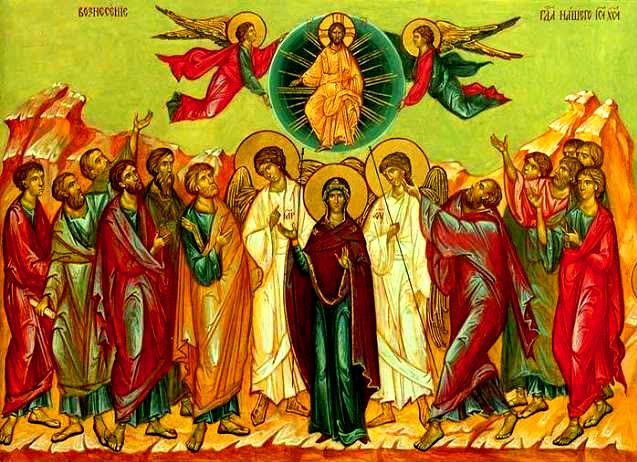

The Ascension of Our Lord

Acts 1:1-11

In the first book, Theophilus,
I dealt with all that Jesus did and taught
until the day he was taken up,
after giving instructions through the Holy Spirit
to the apostles whom he had chosen.
He presented himself alive to them
by many proofs after he had suffered,
appearing to them during forty days
and speaking about the kingdom of God.
While meeting with the them,
he enjoined them not to depart from Jerusalem,
but to wait for “the promise of the Father
about which you have heard me speak;
for John baptized with water,
but in a few days you will be baptized with the Holy Spirit.”

When they had gathered together they asked him,
“Lord, are you at this time going to restore the kingdom to Israel?”
He answered them, “It is not for you to know the times or seasons
that the Father has established by his own authority.
But you will receive power when the Holy Spirit comes upon you,
and you will be my witnesses in Jerusalem,
throughout Judea and Samaria,
and to the ends of the earth.”
When he had said this, as they were looking on,
he was lifted up, and a cloud took him from their sight.
While they were looking intently at the sky as he was going,
suddenly two men dressed in white garments stood beside them.
They said, “Men of Galilee,
why are you standing there looking at the sky?
This Jesus who has been taken up from you into heaven
will return in the same way as you have seen him going into heaven.”

Into the Hands of Foreigners

Save us, Lord, collect us together from among the nations. Alleluia.

Psalm 105 (106)

They mingled themselves with the peoples,
and learned to do as they did.
They served the same idols
until it became their undoing.
They sacrificed their own sons
and their daughters to demons.
They poured out innocent blood.
The blood of their own sons and daughters
was sacrificed to the idols of Canaan.
Their blood polluted the land,
and their actions defiled them.
They devoted themselves to whoring.
The Lord blazed out in anger against his own people,
He detested his own chosen race.
He gave them into the hands of foreigners.
They were conquered by those who hated them.

These words from today’s Office of Readings, I find frightening in light of our society.  We are blessed by the knowledge that God, who is near to us, has blessed us, giving us His Son and sending us His Holy Spirit.  Sinners get to live as saints should they so desire. What does our society reveal about our desires.

What does our society testify about us as a people?  Gifts, even gifts of God, can be squandered by prodigal sons and daughters. His greatest gift, life, we subject to pluralistic debate and countermand by man-made law. ‘Choice’ is elevated above conscience and morality and enshrined as a god to be fed by money-making mills. Is this license the best we can do with the gift of life in a land of freedom and liberty?

Facts about fetal pain.

More facts about fetal pain.

Facts about maternal pain.

Just the facts

Blazing Anger – Triumphant Day

The crew of Divine Office.org in a “chatter & cheese” segment (spontaneous sharing after prayer), brought up a certain delight in God’s burning anger that we have been hearing about in the readings from the Book of Revelation for the last week or so.  The delight springs from a desire for justice that has been long awaited by the saints, martyrs, and, now by us in this Age.  Finall, the raging anger and wrath of God lays low all His enemies who throughout time have set themselves against Him, and caused suffering for His People.

One prevalent thought that emerged in the discussion voiced the notion that this Day of Wrath was in fact the Day of the Cross-the Crucifixion and Death of our Lord Jesus- the Day an unsuspecting Satan was conquered for all time and Eternity by the bloody sacrifice on Calvary.

“Then I saw the heavens opened, and there was a white horse; its rider was (called) “Faithful and True.” He judges and wages war in righteousness. His eyes were (like) a fiery flame, and on his head were many diadems. He had a name  inscribed that no one knows except himself. He wore a cloak that had been dipped in  blood, and his name was called the Word of God.” Rev. 19:11-13

The discussion voiced another light, “The One on the Horse is Jesus.” Chris, said, “Maybe that battle was fought and won.” This Mystery, still unfolding in the world and in the Church in Time is one of triumph and exaltation of the King of Kings who is at hand and enthroned in Heaven and in His Church.

Another thought reflected the idea of transformation, transformation through the sacraments, through Baptism, Confirmation, Eucharist, Matrimony, Holy Orders.  “Burning anger is transformative, purifying.” We are transformed, become new creatures and are yet being fit for the Kingdom, here and yet to come, already but not yet, ”Yesterday, today and tomorrow.”

I image the Mystery of it in this way: it is as a block buster movie being made; when complete, the movie is presented as a whole, but in the process of becoming, it is made up of bits and pieces filmed at different times and different places, yet all part of the complete work and necessary to it.  We are being spliced into the triumphant victory of the Day of the Lord, so to speak, as each of us contributes her/his part.

Maranatha!

St. Athanasius – Bishop of Alexandria – Church Father

St. Athanasius is a favorite “all time tough guy” of Fr. Jeff Wharton.  Fr. Jeff comments that Athanasius lived in a time of errant teaching among priest and bishops and didn’t flinch in defending the Son as “homo-ousios” (meaning “of the same substance, or nature, or essence”) with the Father.  The term, itself, is one that grew out of the Council of Nicea to clarify the Church’s understanding of the Nature of Son as one with the Father. St Athanasius was to spend his life defending the full deity of Christ against emperors, magistrates, bishops, and theologians; James Kiefer explains that for this, he was regarded as a trouble-maker and banished from Alexandria a total of five times by various emperors. Hence the expression “Athanasius contra mundum,” or, “Athanasius against the world.”

James E. Kiefer writes of St. Athanasius:

Outside the pages of the New Testament itself, Athanasius is probably the man to whom we chiefly owe the preservation of the Christian faith. He was born around AD 298, and lived in Alexandria, Egypt, the chief center of learning of the Roman Empire.

In 313 the Emperor Constantine issued the Edict of Milan, which changed Christianity from a persecuted to an officially favored religion. About six years later, a presbyter (elder, priest) Arius of Alexandria began to teach concerning the Word of God (John 1:1) that “God begat him, and before he was begotten, he did not exist.” Athanasius was at that time a newly ordained deacon, secretary to Bishop Alexander of Alexandria, and a member of his household. His reply to Arius was that the begetting, or uttering, of the Word by the Father is an eternal relation between Them, and not a temporal event. Arius was condemned by the bishops of Egypt (with the exceptions of Secundus of Ptolemais and Theonas of Marmorica), and went to Nicomedia, from which he wrote letters to bishops throughout the world, stating his position.

The Emperor Constantine undertook to resolve the dispute by calling a council of bishops from all over the Christian world. This council met in Nicea, just across the straits from what is now Istanbul, in the year 325, and consisted of 317 bishops. Athanasius accompanied his bishop to the council, and became recognized as a chief spokesman for the view that the Son was fully God, co-equal and co-eternal with the Father.

Those were tumultuous times, the bishops gathered by Constantine were men who lived through the persecutions of the time and bore the scars of living martyrdom in testimony to their faith. Can you imagine their meeting one another in one great hall after their years of torture, lonely exile and torment suffered for the defense of  the Faith?

Athanasius is the perfect model for our day.  As best I can remember, Fr. Wharton said, “So much is not right in this world.  Let it lead us to a zeal for the work and Word of God.”  We, too, can bring Truth to the fore with love, leaving off anger that distresses our balance and prayer, that the Holy Spirit may use us mightily, doing great things even in little ways.

St. Teresa of the Andes – Letter 115

I am having trouble being in the world, but not of it. Paul’s word’s challenge me.  Pope Benedict XVI wants them to push me into the mind of Paul and the arms of the Holy Spirit. “Do not conform yourselves to this age but be transformed by the renewal of your mind, that you may discern what is the will of God, what is good and pleasing and perfect.” Romans 12:2

As Pentecost draws near, I’m reminded that it is the Holy Spirit not my spirit that will transform me into conformity with Christ of the Cross and the Resurrection. Tomorrow morning, God willing, I’ll find myself before the Blessed Sacrament once again.  Here are the words I will take with me into the silence:

“How poor, how graceless, as I see it, the worship we offer to God sacramentally present! What scant respect we have for the One before whom the seraphim cover themselves with their wings, prostrating themselves before Him. And He bears it all in silence, remaining without splendor, hidden beneath the bread, that He may live in the midst of those He created. Oh, how good He is! What infinite love He has! Why aren’t we crazy with love for Him?”  St. Teresa of the Andes – Letter 115