He is Risen! – Alleluia!

Happy Easter Everyone!  Alleluia!
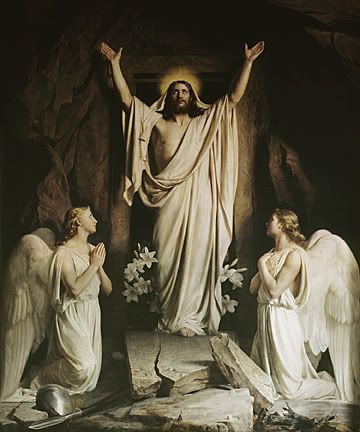
Homily of Pope Benedict XVI  – Easter Sunday 2009

“Christ, our Paschal lamb, has been sacrificed!” (1 Cor 5:7).  On this day, Saint Paul’s triumphant words ring forth, words that we have just heard in the second reading, taken from his First Letter to the Corinthians.  It is a text which originated barely twenty years after the death and resurrection of Jesus, and yet – like many Pauline passages – it already contains, in an impressive synthesis, a full awareness of the newness of life in Christ.  The central symbol of salvation history – the Paschal lamb – is here identified with Jesus, who is called “our Paschal lamb”.  The Hebrew Passover, commemorating the liberation from slavery in Egypt, provided for the ritual sacrifice of a lamb every year, one for each family, as prescribed by the Mosaic Law.  In his passion and death, Jesus reveals himself as the Lamb of God, “sacrificed” on the Cross, to take away the sins of the world.  He was killed at the very hour when it was customary to sacrifice the lambs in the Temple of Jerusalem.  The meaning of his sacrifice he himself had anticipated during the Last Supper, substituting himself – under the signs of bread and wine – for the ritual food of the Hebrew Passover meal.  Thus we can truly say that Jesus brought to fulfilment the tradition of the ancient Passover, and transformed it into his Passover.

On the basis of this new meaning of the Paschal feast, we can also understand Saint Paul’s interpretation of the “leaven”.  The Apostle is referring to an ancient Hebrew usage:  according to which, on the occasion of the Passover, it was necessary to remove from the household every tiny scrap of leavened bread.  On the one hand, this served to recall what had happened to their forefathers at the time of the flight from Egypt:  leaving the country in haste, they had brought with them only unleavened bread.  At the same time, though, the “unleavened bread” was a symbol of purification:  removing the old to make space for the new.  Now, Saint Paul explains, this ancient tradition likewise acquires a new meaning, once more derived from the new “Exodus”, which is Jesus’ passage from death to eternal life.  And since Christ, as the true Lamb, sacrificed himself for us, we too, his disciples – thanks to him and through him – can and must be the “new dough”, the “unleavened bread”, liberated from every residual element of the old yeast of sin:  no more evil and wickedness in our heart.

“Let us celebrate the feast … with the unleavened bread of sincerity and truth”.  This exhortation from Saint Paul, which concludes the short reading that was proclaimed a few moments ago, resounds even more powerfully in the context of the Pauline Year.  Dear brothers and sisters, let us accept the Apostle’s invitation;  let us open our spirit to Christ, who has died and is risen in order to renew us, in order to remove from our hearts the poison of sin and death, and to pour in the life-blood of the Holy Spirit:  divine and eternal life.  In the Easter Sequence, in what seems almost like a response to the Apostle’s words, we sang:  “Scimus Christum surrexisse a mortuis vere” – we know that Christ has truly risen from the dead.  Yes, indeed!  This is the fundamental core of our profession of faith;  this is the cry of victory that unites us all today.  And if Jesus is risen, and is therefore alive, who will ever be able to separate us from him?  Who will ever be able to deprive us of the love of him who has conquered hatred and overcome death?

The Easter proclamation spreads throughout the world with the joyful song of the Alleluia.  Let us sing it with our lips, and let us sing it above all with our hearts and our lives, with a manner of life that is “unleavened”, that is to say, simple, humble, and fruitful in good works.  “Surrexit Christus spes mea:  precedet suos in Galileam” – Christ my hope is risen, and he goes before you into Galilee.  The Risen One goes before us and he accompanies us along the paths of the world.  He is our hope, He is the true peace of the world.  Amen!

Divine Mercy Novena – Day 2

Divine Mercy Novena

Day 2


Today bring to Me the Souls of Priests and Religious, Priests and Religious,
and immerse them in My unfathomable mercy. It was they who gave me strength to endure My bitter Passion. Through them as through channels My mercy flows out upon mankind.”

Most Merciful Jesus, from whom comes all that is good, increase Your grace in men and women consecrated to Your service,* that they may perform worthy works of mercy; and that all who see them may glorify the Father of Mercy who is in heaven.

Eternal Father, turn Your merciful gaze upon the company of chosen ones in Your vineyard — upon the souls of priests and religious; and endow them with the strength of Your blessing. For the love of the Heart of Your Son in which they are enfolded, impart to them Your power and light, that they may be able to guide others in the way of salvation and with one voice sing praise to Your boundless mercy for ages without end. Amen.

Divine Mercy Novena – Day 1

Divine Mercy Novena

Day 1

“Today bring to Me all mankind, especially all sinners,

and immerse them in the ocean of My mercy. In this way you will console Me in the bitter grief in to which the loss of souls plunges Me.”

Most Merciful Jesus, whose very nature it is to have compassion on us and to forgive us, do not look upon our sins but upon our trust which we place in Your infinite goodness. Receive us all into the abode of Your Most Compassionate Heart, and never let us escape from It. We beg this of You by Your love which unites You to the Father and the Holy Spirit.

Eternal Father, turn Your merciful gaze upon all mankind and especially upon poor sinners, all enfolded in the Most Compassionate Heart of Jesus. For the sake of His sorrowful Passion show us Your mercy, that we may praise the omnipotence of Your mercy for ever and ever. Amen.

Foot Washing at Washington Park

It speaks for itself.

Console Jesus in the Garden


From Story of a Soul by St. Therese of Lisieux:

How can a soul so imperfect as mine aspire to the plenitude of
Love? What is the key of this mystery? O my only Friend, why dost
Thou not reserve these infinite longings to lofty souls, to the
eagles that soar in the heights? Alas! I am but a poor little
unfledged bird. I am not an eagle, I have but the eagle's eyes and
heart! Yet, notwithstanding my exceeding littleness, I dare to
gaze upon the Divine Sun of Love, and I burn to dart upwards unto
Him! I would fly, I would imitate the eagles; but all that I can
do is to lift up my little wings--it is beyond my feeble power to
soar. What is to become of me? Must I die of sorrow because of my
helplessness? Oh, no! I will not even grieve. With daring
self-abandonment there will I remain until death, my gaze fixed
upon that Divine Sun. Nothing shall affright me, nor wind nor
rain. And should impenetrable clouds conceal the Orb of Love, and
should I seem to believe that beyond this life there is darkness
only, that would be the hour of perfect joy, the hour in which to
push my confidence to its uttermost bounds. I should not dare to
detach my gaze, well knowing that beyond the dark clouds the sweet
Sun still shines.

So far, O my God, I understand Thy Love for me. But Thou knowest
how often I forget this, my only care. I stray from Thy side, and
my scarcely fledged wings become draggled in the muddy pools of
earth; then I lament "like a young swallow,"and my lament
tells Thee all, and I remember, O Infinite Mercy! that "Thou didst
not come to call the just, but sinners."

Yet shouldst Thou still be deaf to the plaintive cries of Thy
feeble creature, shouldst Thou still be veiled, then I am content
to remain benumbed with cold, my wings bedraggled, and once more I
rejoice in this well-deserved suffering.

O Sun, my only Love, I am happy to feel myself so small, so frail
in Thy sunshine, and I am in peace . . . I know that all the
eagles of Thy Celestial Court have pity on me, they guard and
defend me, they put to flight the vultures--the demons that fain
would devour me. I fear them not, these demons, I am not destined
to be their prey, but the prey of the Divine Eagle.

O Eternal Word! O my Saviour! Thou art the Divine Eagle Whom I
love--Who lurest me. Thou Who, descending to this land of exile,
didst will to suffer and to die, in order to bear away the souls
of men and plunge them into the very heart of the Blessed
Trinity--Love's Eternal Home! Thou Who, reascending into
inaccessible light, dost still remain concealed here in our vale
of tears under the snow-white semblance of the Host, and this, to
nourish me with Thine own substance! O Jesus! forgive me if I tell
Thee that Thy Love reacheth even unto folly. And in face of this
folly, what wilt Thou, but that my heart leap up to Thee? How
could my trust have any limits?

I know that the Saints have made themselves as fools for Thy sake;
being 'eagles,' they have done great things. I am too little for
great things, and my folly it is to hope that Thy Love accepts me
as victim; my folly it is to count on the aid of Angels and
Saints, in order that I may fly unto Thee with thine own wings, O
my Divine Eagle! For as long a time as Thou willest I shall
remain--my eyes fixed upon Thee. I long to be allured by Thy
Divine Eyes; I would become Love's prey. I have the hope that Thou
wilt one day swoop down upon me, and, bearing me away to the
Source of all Love, Thou wilt plunge me at last into that glowing
abyss, that I may become for ever its happy Victim.

O Jesus! would that I could tell all _little souls_ of Thine
ineffable condescension! I feel that if by any possibility Thou
couldst find one weaker than my own, Thou wouldst take delight in
loading her with still greater favours, provided that she
abandoned herself with entire confidence to Thine Infinite Mercy.
But, O my Spouse, why these desires of mine to make known the
secrets of Thy Love? Is it not Thyself alone Who hast taught them
to me, and canst Thou not unveil them to others? Yea! I know it,
and this I implore Thee! . . .

I ENTREAT THEE TO LET THY DIVINE EYES REST UPON A VAST NUMBER OF
LITTLE SOULS, I ENTREAT THEE TO CHOOSE, IN THIS WORLD, A LEGION OF
LITTLE VICTIMS OF THY LOVE.
(The Project Gutenberg EBook of The Story of a Soul (L'Histoire d'une Ame)


Holy Thursday – Pope Benedict XVI

In this day of “turning the Bible on its head by such influential entities as National Geographic Society and Newsweek, it is good to remember what actual scholars who care about Truth have taught us.  Pope Benedict XVI reacting to a misleading 3rd century coptic text on display by the National Geographic Society in 2006, as covered by Cindy Wooden of Catholic New Service, corrected:

Judas was a greedy liar who put his desire for money ahead of his relationship with Jesus and his love for God, Pope Benedict XVI said…

But during his April 13 (2006) homily at the Holy Thursday Mass of the Lord’s Supper, Pope Benedict said Judas is the clearest example Christians have of someone who refuses God’s saving love.

For Judas, the pope said, “only power and success are real; love does not count.”

“And he is greedy: Money is more important than communion with Jesus, more important than God and his love. He also becomes a liar, a double-crosser who breaks with the truth,” Pope Benedict said.

Purposefully ignoring the truth, he said, Judas “hardens, becoming incapable of conversion … and throws away his destroyed life.”

The next day, the pope’s preacher also weighed in against the recent wave of “pseudohistorical literature” gaining popularity as well as the soon-to-be-released film, “The Da Vinci Code.”

In his April 14 [2006] homily during the Good Friday liturgy of the Lord’s Passion, Capuchin Father Raniero Cantalamessa said that millions of people today were being “crassly manipulated by the media,” which is more interested in touting the newest fad or insight rather than the truth and, as a consequence, turning a pretty penny for it.

“There is much talk about Judas’ betrayal without realizing that it is being repeated” today, he said during his homily given before the pope and hundreds of people in St. Peter’s Basilica.

“Christ is being sold again,” he said, but this time “to publishers and booksellers” for billions of dollars.

People seem to be always itching for something new, and there are those who take advantage of that by carrying out or promoting “the clever rewriting of ancient legends,” he said.

The fantasies and speculation will only “flare up with the imminent release of a certain film,” the Capuchin friar said, in reference to the movie “The Da Vinci Code,” based on the novel by Dan Brown.

The preacher of the papal household said he felt it was his duty to address the current swirl of controversy surrounding the many interpretations of the life and death of Jesus because “we cannot allow the silence of believers to be mistaken for embarrassment” nor allow the media to manipulate the truth about Christ’s life, his death on the cross and his resurrection.”

Zenit.org reports Fr. Cantalamessa’s closing remark:

The “fantasies” mentioned have an explanation, concluded the Pontifical Household preacher: “We are in the age of the media and the media are more interested in novelty than in truth.”

Words of St. Paul:

“The time is sure to come when people will not accept sound teaching, but their ears will be itching for anything new and they will collect themselves a whole series of teachers according to their own tastes; and then they will shut their ears to the truth and will turn to myths.”