St. Justin Martyr: First Apology: chapters 48 -59
Day 16 Lite Version
St. Justin Martyr: First Apology:54-60
Compilation of Lenten readings
Printer-Friendly Version of Outline: Church Fathers Lenten Reading Plan PDF
St. Justin Martyr: First Apology: chapters 48 -59
Day 16 Lite Version
St. Justin Martyr: First Apology:54-60
Printer-Friendly Version of Outline: Church Fathers Lenten Reading Plan PDF
“In Lent, we grasp our humanity” says Fr. Jeffrey Whorton. That we need a reminder at all amazes me. I am in awe of the fact that I, a soft bodied creature, am still alive, after more than half a century, in this universe of whirling planets, exploding stars and expanding space. Extrapolating from today’s Gospel, Fr. Whorton points to the hedges God places around us for our survival. In Jesus’ parable, He tells of a landowner who planted a vineyard and put a hedge around it (Matthew 31: 23)
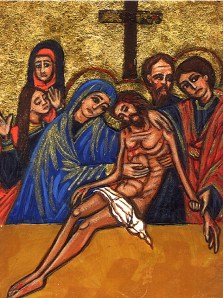
In nature and the Cosmos, Earth is protected by natural laws which set the rhythms of the tides, confine the seas to their basins and keep the very air we breath from drifting off into space. While in the spiritual life, God’s children also have a hedge. Before we knew the Grace of God, we were given the Law of God. God’s people were to live not unfettered by human respect but by a Golden Rule which revealed the freedom of morally. When the Grace of God arrived incarnated in Jesus Christ, love went beyond this Law to lead us to lay down our lives for one another, the supernature wed to the natural. Lent points to our failure in this respect. It is precisely here, that we find another hedge protecting us from the Accuser and self-condemnation by an Incarnated Mercy, Whose love and forgiveness knows no bounds.
In daily life, the teachings of the Church provide a hedge against a license and an immorality that would favor the animal side of our natures. Without the hedge of revealed Truth and instruction, we are deprived, and left to our sinfulness, which is more an inhuman nature. Our humanity was glorified by Christ once Jesus put it on as a mantle clothing His Divinity. However, it still needs the individual response of our consent and cooperation. Now, we are hedged by the very flesh of our Savior, and called to be truly human as revealed by Christ.
According to Fr.Whorton, “The glory and the tragedy of the Church is that the Church is on display.” In our world of brute forces and competing philosophies and errors, we are called to shine like stars (Phil.2: 15), like sparks among the stubble (Wisdom 3:7). Fr. Whorton asks, as does Lent, itself, “Am I displaying the glory or the tragedy?”
As the 14th day of Lent draws to a close, Nelson shares these thoughts from the letter of Patriarch Gregorios III of Antioch (Melkite) for Lent that I’m passing on:
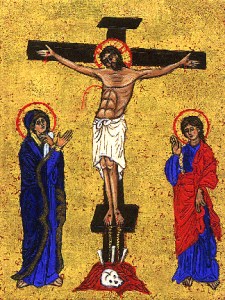
“Indeed, if the cross, with all that it represents, with all that it signifies, symbolises and indicates, of sufferings, sicknesses, disasters, various afflictions, catastrophes, pains and injuries to which all people are subject, if the cross is a constituent reality of all human life, there is an obligation for all people, like Jesus, to carry the cross together, in order to disburden the one charged with it and together to bear it with love and solidarity. In this letter, I am urging my faithful sons and daughters of the Melkite Greek Catholic Church in the Arab world and throughout the world to be in solidarity with each other and stand shoulder to shoulder with their brethren, friends, neighbours and fellow-citizens to bear the cross together on the way of the cross, especially during these days of Great Lent on our common spiritual Lenten way towards the Feast and the joy of the glorious Resurrection.”
I pray that all Christians may be one and bear faithful witness to the One who is all in all.
St. Justin Martyr: First Apology: chapters 36-47
Day 15 Lite Version
St. Justin Martyr: First Apology:46-53
Printer-Friendly Version of Outline: Church Fathers Lenten Reading Plan PDF
From the Office of the Day – St Hilary, Early Church Father & Doctor of the Church:
“Fear” is not to be taken in the sense that common usage gives it. Fear in this ordinary sense is the trepidation our weak humanity feels when it is afraid of suffering something it does not want to happen. We are afraid, or made afraid, because of a guilty conscience, the rights of someone more powerful, an attack from one who is stronger, sickness, encountering a wild beast, suffering evil in any form. This kind of fear is not taught: it happens because we are weak. We do not have to learn what we should fear: objects of fear bring their own terror with them.
From the Office of the Day – But of the fear of the Lord this is what is written: Come, my children, listen to me, I shall teach you the fear of the Lord. The fear of the Lord has then to be learned because it can be taught. It does not lie in terror, but in something that can be taught. It does not arise from the fearfulness of our nature; it has to be acquired by obedience to the commandments, by holiness of life and by knowledge of the truth.
For us the fear of God consists wholly in love, and perfect love of God brings our fear of him to its perfection. Our love for God is entrusted with its own responsibility: to observe his counsels, to obey his laws, to trust his promises.
Day 14 Church Fathers Lenten Reading Plan 3/12/09
St. Justin Martyr: First Apology: chapters 24-35
Day 14 Lite Version
St. Justin Martyr: First Apology: 38-45
Printer-Friendly Version of Outline: Church Fathers Lenten Reading Plan PDF