The Eucharist, Pledge of Our Resurrection

From the treatise Against Heresies by Saint Irenaeus,

The eucharist, pledge of our resurrection

If our flesh is not saved, then the Lord has not redeemed us with his blood, the eucharistic chalice does not make us sharers in his blood, and the bread we break does not make us sharers in his body. There can be no blood without veins, flesh and the rest of the human substance, and this the Word of God actually became: it was with his own blood that he redeemed us. As the Apostle says: In him, through his blood, we have been redeemed, our sins have been forgiven.

We are his members and we are nourished by creatures, which is his gift to us, for it is he who causes the sun to rise and the rain to fall. He declared that the chalice, which comes from his creation, was his blood, and he makes it the nourishment of our blood. He affirmed that the bread, which comes from his creation, was his body, and he makes it the nourishment of our body. When the chalice we mix and the bread we bake receive the word of God, the eucharistic elements become the body and blood of Christ, by which our bodies live and grow. How then can it be said that flesh belonging to the Lord’s own body and nourished by his body and blood is incapable of receiving God’s gift of eternal life? Saint Paul says in his letter to the Ephesians that we are members of his body, of his flesh and bones. He is not speaking of some spiritual and incorporeal kind of man, for spirits do not have flesh and bones. He is speaking of a real human body composed of flesh, sinews and bones, nourished by the chalice of Christ’s blood and receiving growth from the bread which is his body.

The slip of a vine planted in the ground bears fruit at the proper time. The grain of wheat falls into the ground and decays only to be raised up again and multiplied by the Spirit of God who sustains all things. The Wisdom of God places these things at the service of man and when they receive God’s word they become the eucharist, which is the body and blood of Christ. In the same way our bodies, which have been nourished by the eucharist, will be buried in the earth and will decay, but they will rise again at the appointed time, for the Word of God will raise them up to the glory of God the Father. Then the Father will clothe our mortal nature in immortality and freely endow our corruptible nature with incorruptibility, for God’s power is shown most perfectly in weakness.
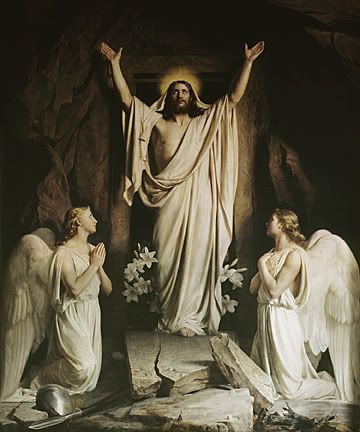
The Easter Praise of Christ

From an Easter homily by Melito of Sardis, bishop

The Easter praise of Christ

We should understand, beloved, that the paschal mystery is at once old and new, transitory and eternal, corruptible and incorruptible, mortal and immortal. In terms of the Law it is old, in terms of the Word it is new. In its figure it is passing, in its grace it is eternal. It is corruptible in the sacrifice of the lamb, incorruptible in the eternal life of the Lord. It is mortal in his burial in the earth, immortal in his resurrection from the dead.

The Law indeed is old, but the Word is new. The type is transitory, but grace is eternal. The lamb was corruptible, but the Lord is incorruptible. He was slain as a lamb; he rose again as God. He was led like a sheep to the slaughter, yet he was not a sheep. He was silent as a lamb, yet he was not a lamb. The type has passed away; the reality has come. The lamb gives place to God, the sheep gives place to a man, and the man is Christ, who fills the whole of creation. The sacrifice of the lamb, the celebration of the Passover, and the prescriptions of the Law have been fulfilled in Jesus Christ. Under the old Law, and still more under the new dispensation, everything pointed toward him.

Both the Law and the Word came forth from Zion and Jerusalem, but now the Law has given place to the Word, the old to the new. The commandment has become grace, the type a reality. The lamb has become a Son, the sheep a man, and man, God.

The Lord, though he was God, became man. He suffered for the sake of those who suffer, he was bound for those in bonds, condemned for the guilty, buried for those who lie in the grave; but he rose from the dead, and cried aloud: Who will contend with me? Let him confront me. I have freed the condemned, brought the dead back to life, raised men from their graves. Who has anything to say against me? I, he said, am the Christ; I have destroyed death, triumphed over the enemy, trampled hell underfoot, bound the strong one, and taken men up to the heights of heaven: I am the Christ.

Come, then, all you nations of men, receive forgiveness for the sins that defile you. I am your forgiveness. I am the Passover that brings salvation. I am the lamb who was immolated for you. I am your ransom, your life, your resurrection, your light, I am your salvation and your king. I will bring you to the heights of heaven. With my own right hand I will raise you up, and I will show you the eternal Father.

He is Risen! – Alleluia!

Happy Easter Everyone!  Alleluia!

Homily of Pope Benedict XVI  – Easter Sunday 2009

“Christ, our Paschal lamb, has been sacrificed!” (1 Cor 5:7).  On this day, Saint Paul’s triumphant words ring forth, words that we have just heard in the second reading, taken from his First Letter to the Corinthians.  It is a text which originated barely twenty years after the death and resurrection of Jesus, and yet – like many Pauline passages – it already contains, in an impressive synthesis, a full awareness of the newness of life in Christ.  The central symbol of salvation history – the Paschal lamb – is here identified with Jesus, who is called “our Paschal lamb”.  The Hebrew Passover, commemorating the liberation from slavery in Egypt, provided for the ritual sacrifice of a lamb every year, one for each family, as prescribed by the Mosaic Law.  In his passion and death, Jesus reveals himself as the Lamb of God, “sacrificed” on the Cross, to take away the sins of the world.  He was killed at the very hour when it was customary to sacrifice the lambs in the Temple of Jerusalem.  The meaning of his sacrifice he himself had anticipated during the Last Supper, substituting himself – under the signs of bread and wine – for the ritual food of the Hebrew Passover meal.  Thus we can truly say that Jesus brought to fulfilment the tradition of the ancient Passover, and transformed it into his Passover.

On the basis of this new meaning of the Paschal feast, we can also understand Saint Paul’s interpretation of the “leaven”.  The Apostle is referring to an ancient Hebrew usage:  according to which, on the occasion of the Passover, it was necessary to remove from the household every tiny scrap of leavened bread.  On the one hand, this served to recall what had happened to their forefathers at the time of the flight from Egypt:  leaving the country in haste, they had brought with them only unleavened bread.  At the same time, though, the “unleavened bread” was a symbol of purification:  removing the old to make space for the new.  Now, Saint Paul explains, this ancient tradition likewise acquires a new meaning, once more derived from the new “Exodus”, which is Jesus’ passage from death to eternal life.  And since Christ, as the true Lamb, sacrificed himself for us, we too, his disciples – thanks to him and through him – can and must be the “new dough”, the “unleavened bread”, liberated from every residual element of the old yeast of sin:  no more evil and wickedness in our heart.

“Let us celebrate the feast … with the unleavened bread of sincerity and truth”.  This exhortation from Saint Paul, which concludes the short reading that was proclaimed a few moments ago, resounds even more powerfully in the context of the Pauline Year.  Dear brothers and sisters, let us accept the Apostle’s invitation;  let us open our spirit to Christ, who has died and is risen in order to renew us, in order to remove from our hearts the poison of sin and death, and to pour in the life-blood of the Holy Spirit:  divine and eternal life.  In the Easter Sequence, in what seems almost like a response to the Apostle’s words, we sang:  “Scimus Christum surrexisse a mortuis vere” – we know that Christ has truly risen from the dead.  Yes, indeed!  This is the fundamental core of our profession of faith;  this is the cry of victory that unites us all today.  And if Jesus is risen, and is therefore alive, who will ever be able to separate us from him?  Who will ever be able to deprive us of the love of him who has conquered hatred and overcome death?

The Easter proclamation spreads throughout the world with the joyful song of the Alleluia.  Let us sing it with our lips, and let us sing it above all with our hearts and our lives, with a manner of life that is “unleavened”, that is to say, simple, humble, and fruitful in good works.  “Surrexit Christus spes mea:  precedet suos in Galileam” – Christ my hope is risen, and he goes before you into Galilee.  The Risen One goes before us and he accompanies us along the paths of the world.  He is our hope, He is the true peace of the world.  Amen!

Dismiss All Other Loves!

Red draped the Crucifix as it proceeded amidst waving palm branches – blood red! Shouts of “Hail and hosanna” would soon change to “Crucify!” It is so brief a time to reign and be acknowledged as the Holy One of God.  Our homilist, Fr. Michael De Palma asked what happened? For the Church, not many weeks ago, we were gazing on the face of the Christ Child.  Angels sang and Wise Men bowed low. We sang:

Sacred Infant, all Divine,

What a tender love was Thine;

Thus to come from highest bliss

Down to such a world as this !

Teach, oh, teach us, Holy Child,

By Thy face so meek and mild.

Teach us to resemble Thee,

In Thy sweet humility !

What happened?  Have we, too, dismissed Him?  He reigns on our calendars, but what about our hearts? What other loves have replaced Him in our day to day?  Can we bear to look upon His disfigured Face?  Can we “Behold the Man?.”

Father Michael invited us to live this week differently from all others, to banish all other loves and gaze upon one bruised and bloodied Face.  Angels trembled at what we had done to the Son of God.  They trembled, too, at what He accomplished on that Cross for me and you.

We will soon sing with the Church around the world:

O Sacred Head, surrounded
by crown of piercing thorn!
O bleeding head, so wounded,
reviled and put to scorn!
Our sins have marred the glory
of thy most holy face,
yet angel hosts adore thee
and tremble as they gaze

I see thy strength and vigor
all fading in the strife,
and death with cruel rigor,
bereaving thee of life;
O agony and dying!
O love to sinners free!
Jesus, all grace supplying,
O turn thy face on me.

(Words Henry Williams Baker after Bernard of Clairvaux)

One Holy Week remains of Lent.  We are invited to walk these days with our Lord to Calvary.  Without the Cross there is no Resurrection, no Easter glory.  With Christ we, too, can rise again to new Life

“When He is King we will give Him the Kings’ gifts,
Myrrh for its sweetness, and gold for a crown…

When He is King they will clothe Him in grave-sheets,
Myrrh for embalming and wood for a crown..

Bethlehem Down – words by Bruce Blunt

Tell the Story!

I’m beginning today with a question: How did the first Christians do it?

In a world of propaganda and hype, of relativism and materialism, I ask myself what do I have that can change darkness into Light?  In truth, I have what Christians have had from the beginning.  I have the Savior of the world. Jesus words after His Resurrection from the dead were:

“Go into the whole world and proclaim the gospel to every creature.” Mark16: 15

In effect, go tell My story!

It is more than a story.  It is power.  It is the single most important act in all of human history with eternal consequences.  The world has run after other gods.  I have run after other gods.  That’s not the end of the story though.

Tomorrow begins Lent.  For myself, I’m resolved to tell the story everyday of Lent.  Lent will change me and then the world.  Like the first Christians,  we must begin by telling the story of  Jesus’ death on the Cross and His Resurrection from the dead.  Proclaim it!

“For God so loved the world that he gave his only Son, so that everyone who believes in him might not perish but might have eternal life. For God did not send his Son into the world to condemn the world, but that the world might be saved through him.Whoever believes in him will not be condemned, but whoever does not believe has already been condemned, because he has not believed in the name of the only Son of  God.” John3:16–18

Paul told us we don’t need to be polished and eloquent.  To the Corinthian Greeks, Paul writes, “I resolved to know nothing while I was with you except Jesus Christ and him crucified.” 1 Corinthians 2:2

That is my story.  I’m resolved to tell it today.