Novena to the Holy Spirit – Day 1

Day 1

“John baptized with water, but in a few days you will be baptized with the holy Spirit.” Acts 1:5

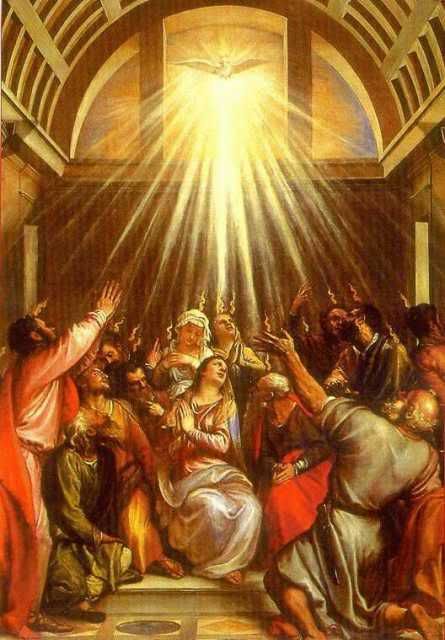
When the time for Pentecost was fulfilled, they were all in one place together. And suddenly there came from the sky a noise like a strong driving wind,  and it filled the entire house in which they were. Then there appeared to them tongues as of fire,  which parted and came to rest on each one of them. And they were all filled with the holy Spirit and began to speak in different tongues,  as the Spirit enabled them to proclaim.  Now there were devout Jews from every nation under heaven staying in Jerusalem.  At this sound, they gathered in a large crowd, but they were confused because each one heard them speaking in his own language. They were astounded, and in amazement they asked, “Are not all these people who are speaking Galileans? Then how does each of us hear them in his own native language? We are Parthians, Medes, and Elamites, inhabitants of Mesopotamia, Judea and Cappadocia, Pontus and Asia,Phrygia and Pamphylia, Egypt and the districts of Libya near Cyrene, as well as travelers from Rome,both Jews and converts to Judaism, Cretans and Arabs, yet we hear them speaking in our own tongues of the mighty acts of God.” They were all astounded and bewildered, and said to one another, “What does this mean?” But others said, scoffing, “They have had too much new wine.” Then Peter stood up with the Eleven, raised his voice, and proclaimed to them, “You who are Jews, indeed all of you staying in Jerusalem. Let this be known to you, and listen to my words. These people are not drunk, as you suppose, for it is only nine o’clock in the morning. No, this is what was spoken through the prophet Joel: ‘It will come to pass in the last days,’ God says, ‘that I will pour out a portion of my spirit upon all flesh. Your sons and your daughters shall prophesy, your young men shall see visions, your old men shall dream dreams. Indeed, upon my servants and my handmaids I will pour out a portion of my spirit in those days, and they shall prophesy.
And I will work wonders in the heavens above and signs on the earth below: blood, fire, and a cloud of smoke. The sun shall be turned to darkness, and the moon to blood, before the coming of the great and splendid day of the Lord,and it shall be that everyone shall be saved who calls on the name of the Lord.’ Acts 2:1-21
God my creator

Breathe on me again

Renew me-Refresh me

Extend my abilities-Give me your gifts

Body and Blood of Jesus Christ

Flow through every fiber of my being

Keep me well

Oh Holy Spirit use me.

Our Father; Hail Mary; Glory be to the Father, the Son and the Holy Spirit…

Open Letter-Fr.Jenkins/Notre Dame by Arrested Women

An Open Letter to Fr. John Jenkins
President
University of Notre Dame

Dear Fr. Jenkins,We are writing this letter to you in hopes that you can clear something up for us.

We are two Catholic women who reside in the State of Colorado. We made tragic mistakes in our younger years by having abortions. We came to the University of Notre Dame last Friday, May 8, to witness to the harm caused to us by our “choice.” We held signs that say “I Regret My Abortion”. We also gave our testimonies and prayed the Rosary with other Catholics who supported us.

We did this in hopes of saving young women years of pain, shame and guilt. We did this because college aged women have the most abortions. We did this because we wanted these young women to know that women deserve better than abortion and that women can achieve the things that they want without having their babies killed. We did this because we believe in the fundamental right to life of all human beings who are created in the image and likeness of God which is a dogmatic teaching of the Catholic Church.

We have both attended Project Rachel and Rachel’s Vineyard retreats – both Catholic healing programs for those suffering from abortion. We then joined “The Silent No More Awareness campaign”, a program sponsored by a Catholic Priest – Fr. Frank Pavone.

In all of these programs we were taught about the acceptance and mercy of God and our fellow Catholics. Also, in these programs we were encouraged to seek the counsel of a Catholic Priest – that they would help us to find redemption in the sacrament of reconciliation. We were also encouraged to share our stories so that the Catholic community and the greater community at large could hear first hand of the devastating effects of abortion.

While speaking these truths on Friday we were issued a Trespass Notice by security officers hired by the University that in part states “The University has the right to tell us that we are not wanted on University property.”

Imagine our shock after receiving this notice and being barred from speaking further, we were arrested and thrown in jail. We spent the day in a holding cell until we posted a $250 bond. As we now understand things, we are awaiting news as to whether the charges against us will be misdemeanor trespassing or a felony. This happened all because we wanted the students to know through our stories how devastating abortion is to women.

We are confused, Fr. Jenkins. Why would a Catholic University bar Catholic women from speaking the truth about a fundamental Catholic teaching, under the signage of a healing program that is sponsored by a Catholic priest, while praying the Rosary? Yet, the University would welcome, honor and have a person speak at Commencement who is virulently opposed to this same fundamental Catholic teaching?

Fr. Jenkins can you please explain this to us?

We look forward to your response.

Jane Brennan, MS
Laura Rohling
Centennial, CO
www.motherhoodinterrupted.com

Notre Dame- “Intellectual Vanity”- Archbishop Chaput

Archbishop Chaput on Notre Dame – “Notre Dame’s leadership has done a real disservice to the Church.”


“I have found that even among those who did not go to Notre Dame, even among those who do not share the Catholic faith, there is a special expectation, a special hope, for what Notre Dame can accomplish in the world.”
~ Reverend John Jenkins, C.S.C., May 17, 2009

Most graduation speeches are a mix of piety and optimism designed to ease students smoothly into real life. The best have humor. Some genuinely inspire. But only a rare few manage to be pious, optimistic, evasive, sad and damaging all at the same time. Father John Jenkins, C.S.C., Notre Dame’s president, is a man of substantial intellect and ability. This makes his introductory comments to President Obama’s Notre Dame commencement speech on May 17 all the more embarrassing.

Let’s remember that the debate over President Obama’s appearance at Notre Dame was never about whether he is a good or bad man. The president is clearly a sincere and able man. By his own words, religion has had a major influence in his life. We owe him the respect Scripture calls us to show all public officials. We have a duty to pray for his wisdom and for the success of his service to the common good — insofar as it is guided by right moral reasoning.

We also have the duty to oppose him when he’s wrong on foundational issues like abortion, embryonic stem cell research and similar matters. And we also have the duty to avoid prostituting our Catholic identity by appeals to phony dialogue that mask an abdication of our moral witness. Notre Dame did not merely invite the president to speak at its commencement. It also conferred an unnecessary and unearned honorary law degree on a man committed to upholding one of the worst Supreme Court decisions in our nation’s history: Roe v. Wade.

In doing so, Notre Dame ignored the U.S. bishops’ guidance in their 2004 statement, Catholics in Political Life. It ignored the concerns of Ambassador Mary Ann Glendon, Notre Dame’s 2009 Laetare Medal honoree – who, unlike the president, certainly did deserve her award, but finally declined it in frustration with the university’s action. It ignored appeals from the university’s local bishop, the president of the U.S. Catholic bishops’ conference, more than 70 other bishops, many thousands of Notre Dame alumni and hundreds of thousands of other American Catholics. Even here in Colorado, I’ve heard from too many to count.

There was no excuse – none, except intellectual vanity – for the university to persist in its course. And Father Jenkins compounded a bad original decision with evasive and disingenuous explanations to subsequently justify it.

These are hard words, but they’re deserved precisely because of Father Jenkins’ own remarks on May 17: Until now, American Catholics have indeed had “a special expectation, a special hope for what Notre Dame can accomplish in the world.” For many faithful Catholics – and not just a “small but vocal group” described with such inexcusable disdain and ignorance in journals like Time magazine — that changed Sunday.

The May 17 events do have some fitting irony, though. Almost exactly 25 years ago, Notre Dame provided the forum for Gov. Mario Cuomo to outline the “Catholic” case for “pro-choice” public service. At the time, Cuomo’s speech was hailed in the media as a masterpiece of American Catholic legal and moral reasoning. In retrospect, it’s clearly adroit. It’s also, just as clearly, an illogical and intellectually shabby exercise in the manufacture of excuses. Father Jenkins’ explanations, and President Obama’s honorary degree, are a fitting national bookend to a quarter century of softening Catholic witness in Catholic higher education. Together, they’ve given the next generation of Catholic leadership all the excuses they need to baptize their personal conveniences and ignore what it really demands to be “Catholic” in the public square.

Chicago’s Cardinal Francis George has suggested that Notre Dame “didn’t understand” what it means to be Catholic before these events began. He’s correct, and Notre Dame is hardly alone in its institutional confusion. That’s the heart of the matter. Notre Dame’s leadership has done a real disservice to the Church, and now seeks to ride out the criticism by treating it as an expression of fringe anger. But the damage remains, and Notre Dame’s critics are right. The most vital thing faithful Catholics can do now is to insist – by their words, actions and financial support – that institutions claiming to be “Catholic” actually live the faith with courage and consistency. If that happens, Notre Dame’s failure may yet do some unintended good.

Read Catholic Online for Deacon Keith Fournier’s  take on Archbishop Chaput: ‘Notre Dame, the Issues that Remain’

Paul Vitz-The Psychology of Atheism

The Psychology of Atheism by Paul Vitz

Veritas .org has an interesting lecture by psychologist Paul Vitz  on the psychology of atheism.

Apologetics 315 writes:

Vitz lost his faith and became an atheist. Later he returned to Christianity. He explores the psychological reasons for belief and unbelief. A good lecture for the theist and the atheist.

LISTEN

MP3 audio here

Paul Vitz’s book Faith of the Fatherless will be available in Dec 2009

Rio Rancho Church Welcomes Married Priest

Church welcomes their first married priest – KRQE reports.

Father Whorton was ordained in May of 2008 and became part of St. Thomas Aquinas Catholic Church in Rio Rancho.  He talks about his decision to move to the church and the controversy and questions surrounding it.

THE SIDE OF JESUS OPENED

My day began with a the passage I quote below from The Dolorous Passion of Our Lord Jesus Christ by Venerable Catherine Anne Emmerich.  I marvel at the mercy  of God revealed once again in the conversion of the soldier who opened the side of Jesus. In my meditation, that wound in the side of Jesus is my refuge washing me in the blood and water that poured out upon the world.

THE SIDE OF JESUS OPENED. THE LEGS OF THE THIEVES BROKEN. Whilst these events were taking place in Jerusalem, silence reigned around Calvary. The crowd which had been for a time so noisy and tumultuous was dispersed; all were panic-stricken; in scene that panic had produced sincere repentance, but on others it had had no beneficial effects. Mary, John, Magdalen, Mary of Cleophas, and Salome had remained, either standing or sitting before the Cross, closely veiled and weeping silently. A few soldiers were leaning over the terrace which enclosed the platform; Cassius rode up and down; the sky was lowering, and all nature wore a garb of mourning. Six archers soon after made their appearance, bringing with them ladders, spades, ropes, and large iron staves for the purpose of breaking the legs of the criminals, in order to hasten their deaths. When they approached our Lord’s Cross, his friends retired a few paces back, and the Blessed Virgin was seized with fear lest they should indulge their hatred of Jesus by insulting even his dead body. Her fears were not quite unfounded, for when they first placed their ladders against the Cross they declared that he was only pretending to be dead; in a few moments, however, seeing that he was cold and stiff, they left him, and removed their ladders to the crosses on which the two thieves were still hanging alive. They took up their iron staves and broke the arms of the thieves above and below the elbow; while another archer at the same moment broke their legs, both above and below the knee. Gesmas uttered frightful cries, therefore the executioner finished him off by three heavy blows of a cudgel on his chest. Dismas gave a deep groan, and expired: he was the first among mortals who had the happiness of rejoining his Redeemer. The cords were then loosened, the two bodies fell to the ground, and the executioners dragged them to a deep morass, which was between Calvary and the walls of the town, and buried them there. The archers still appeared doubtful whether Jesus was really dead, and the brutality they had shown in breaking the legs of the thieves made the holy women tremble as to what outrage they might next perpetrate on the body of our Lord. But Cassius, the subaltern officer, a young man of about five-and-twenty, whose weak squinting eyes and nervous manner had often excited the derision of his companions, was suddenly illuminated by grace, and being quite overcome at the sight of the cruel conduct of the soldiers, and the deep sorrow of the holy women, determined to relieve their anxiety by proving beyond dispute that Jesus was really dead. The kindness of his heart prompted him, but unconsciously to himself he fulfilled a prophecy. He seized his lance and rode quickly up to the mound on which the Cross was planted, stopped just between the cross of the good thief and that of our Lord, and taking his lance in both hands, thrust it so completely into the right side of Jesus that the point went through the heart, and appeared on the left side. When Cassius drew his lance out of the wound a quantity of blood and water rushed from it, and flowed over his face and body. This species of washing produced effects somewhat similar to the vivifying waters of Baptism: grace and salvation at once entered his soul. He leaped from his horse, threw himself upon his knees, struck his breast, and confessed loudly before all his firm belief in the divinity of Jesus. The Blessed Virgin and her companions were still standing near, with their eyes fixed upon the Cross, but when Cassius thrust his lance into the side of Jesus they were much startled, and rushed with one accord up to it. Mary looked as if the lance had transfixed her heart instead of that of her Divine Son, and could scarcely support herself. Cassius meantime remained kneeling and thanking God, not only for the graces he had received but likewise for the cure of the complaint in his eyes, which had caused the weakness and the squint. This cure had been effected at the same moment that the darkness with which his soul was previously filled was removed. Every heart was overcome at the sight of the blood of our Lord, which ran into a hollow in the rock at the foot of the Cross. Mary, John, the holy women, and Cassius, gathered up the blood and water in flasks, and wiped up the remainder with pieces of linen.* Cassius, whose sight was perfectly restored at the same moment that the eyes of his soul were opened, was deeply moved, and continued his humble prayer of thanksgiving. The soldiers were struck with astonishment at the miracle which had taken place, and cast themselves on their knees by his side, at the same time striking their breasts and confessing to Jesus. The water and blood continued to flow from the large wound in the side of our Lord; it ran into the hollow in the rock, and the holy women put it in vases, while Mary and Magdalen mingled their tears. (Chapter 48)

St. Faustina gave us this prayer from Jesus:

“O Blood and Water, which gushed forth from the Heart of Jesus as a fount of mercy for us, I trust in You.”