
Pat Buchanan asks Is Notre Dame Still Catholic?
Says Ralph McInerny, a philosophy professor since 1955: “By inviting Barack Obama to be the 2009 commencement speaker, Notre Dame has forfeited its right to call itself a Catholic University. … (T)his is a deliberate thumbing of the collective nose at the Roman Catholic Church to which Notre Dame purports to be faithful.
“Faithful? Tell it to Julian the Apostate.”
McInerny calls Father Jenkins’ invitation to Obama worse than the “usual effort of the university to get into warm contact with the power figures of the day. It is an unequivocal abandonment of any pretense at being a Catholic university.”
An honorary degree, writes Catholic author George Weigel, is a statement that here is a man we should admire and emulate. But how can a Catholic university say that about a man who means to appoint Supreme Court justices who will keep constitutional and legal the systematic slaughter of the unborn that has taken 50 million lives in 35 years? Continued…
Tag Archives: Spiritual
Lenten Reading Plan – Apr 1
 Day31Church Fathers Lenten Reading Plan 4/1/09
St. Cyril of Jerusalem: Catechetical Lectures: Lecture XX
Day 31 Lite Version
St. Athanasius: Life of Anthony: 82-89
Compilation of Lenten readings
Printer-Friendly Version of Outline: Church Fathers Lenten Reading Plan PDF
An Urgent Appeal-Fr. Groeschel
Purifying the Church is a work of the Spirit in all ages. The Church is the home of sinners working on being saints. Like the disciples that needed Jesus to wash their feet although they had already been cleansed by Christ, Christians in contact with the world do find that the dust and dirt does stick.
Here I want to repeat a message and spread an appeal made by Fr. Benedict Groeschel, of the Franciscan Friars of the Renewal. He says, some of the very liberal Catholic are calling for all kinds of changes that will leave the Catholic Church no longer the Catholic Church. Fr. Groeschel says, that the Church has be humiliated. It has been demoralized. We are asking what will happen. He says, “Pray! Pray! Pray!………Pray for the Church, pray for the victims and pray for our enemies?”
In an urgent appeal Fr. Groeschel joins EWTN in asking, “What can we do as Catholics and Christians to bring something good out to these most vicious attacks on the Church in the media and society?……Otherwise, we will have what Archbishop Fulton J. Sheen calls ‘wasted suffering’.”
Fr. Groeschel calls for reform; vigilance and reform to carry us forward from this point of humiliation, betrayal and defamation. Here are some areas which need reformation:
1. Liturgy and prayer
It should be reverent devout and worthy. Worship of God is a serious business. Prepare for it! Dress for it!
2. Eucharistic celebration and Reconciliation
Mass should be presented in a manner that supports prayer with appropriate music for all ages that lifts the heart and spirit. It should be prayerful.
3. Catholic education
Many Catholic schools of higher education should not be called Catholic. Many are simply trying to make money – greed!
4. Catholic Social Service and Hospitals
Many Catholic Hospital and Social Services are lacking in areas of Catholic sexual morality and catholic medical ethics. How do you make changes? Write letters!… Begin your letter to schools and hospitals the need change in these areas like this: “Before we do anything else, we thought it was only fair to contact you.”
5. Religious life
According to Fr. Benedict, Catholics can be very stupid. They don’t know how to deal with a theory. They let themselves be influenced by every passing fad. This is what has destroyed people; taking too much from psychology and not enough from the Gospel and from the Tradition of the Found. Give them a theory and they think they have to believe it. Something comes along, call it psychology, call it the ennegram and Catholics have to pick it up and play with it. For His part, Father Groeschel knows what he believes. He believes in the Father, the Son and the Holy Spirit. He doesn’t need to believe in psychology or the creations of pop-culture. Psychology or things masquerading as modern thought have have far too much influence on Catholic thinking. Many Catholic communities are completely lacking in prayer life, in witness to the Gospel. They are openly open disloyalty to Catholic teaching and especially to the Holy Father.
Speak up! Cause trouble! Do not accept the false and mediocre. Resurrect the wonderful spirit of your community’s founder or foundress. Read the Gospel. Read the Catechism of the Catholic Church. Watch out for the influence of psychology. Some things are effective as tools but not as Creed.
6. Issues of Life
Finally, Fr. Groseschel says, “Speak out for Life.” We are not a loud voice. There are millions of Catholics and so far our voice is still a whisper. Get with it. Discover your Catholic heart and passion!
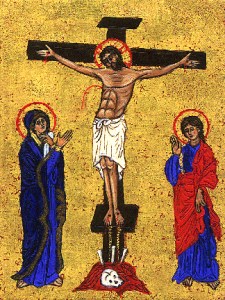
Don’t be surprised that the Church is being crucified. The Church is the Body of Christ. It is going to the Cross. As you call it on it’s sinfulness, don’t exempt yourself. Don’t be afraid of a Crucified Christ. Turn to Christ! Where Satan reigns; the Crucified Conquers! Christ conqueror! Christ captain! Christ command! The Church will come forth purified and one with its Lord.
The Dying of the Little Flower
From The Story of a Soul (L’Histoire d’une Ame):
The Autobiography of St. Therese of Lisieux, by Therese Martin (of Lisieux)
At last dawned the eternal day. It was Thursday, September 30,
1897. In the morning, the sweet Victim, her eyes fixed on Our
Lady’s statue, spoke thus of her last night on earth: “Oh! with
what fervour I have prayed to her! . . . And yet it has been pure
agony, without a ray of consolation. . . . Earth’s air is failing
me: when shall I breathe the air of Heaven?”For weeks she had been unable to raise herself in bed, but, at
half-past two in the afternoon, she sat up and exclaimed: “Dear
Mother, the chalice is full to overflowing! I could never have
believed that it was possible to suffer so intensely. . . . I can
only explain it by my extreme desire to save souls. . . .” And a
little while after: “Yes, all that I have written about my thirst
for suffering is really true! I do not regret having surrendered
myself to Love.”She repeated these last words several times. A little later she
added: “Mother, prepare me to die well.” The good Mother Prioress
encouraged her with these words: “My child, you are quite ready to
appear before God, for you have always understood the virtue of
humility.” Then, in striking words, Therese bore witness to
herself:“Yes, I feel it; my soul has ever sought the truth. . . . I have
understood humility of heart!”. . . . . . .
At half-past four, her agony began–the agony of this “Victim of
Divine Love.” When the Community gathered round her, she thanked
them with the sweetest smile, and then, completely given over to
love and suffering, the Crucifix clasped in her failing hands, she
entered on the final combat. The sweat of death lay heavy on her
brow . . . she trembled . . . but, as a pilot, when close to
harbour, is not dismayed by the fury of the storm, so this soul,
strong in faith, saw close at hand the beacon-lights of Heaven,
and valiantly put forth every effort to reach the shore.As the convent bells rang the evening Angelus, she fixed an
inexpressible look upon the statue of the Immaculate Virgin, the
Star of the Sea. Was it not the moment to repeat her beautiful
prayer:“O thou who camest to smile on me in the morn of my life, come
once again and smile, Mother, for now it is eventide!”[15]A few minutes after seven, turning to the Prioress, the poor
little Martyr asked: “Mother, is it not the agony? . . . am I not
going to die?” “Yes, my child, it is the agony, but Jesus perhaps
wills that it be prolonged for some hours.” In a sweet and
plaintive voice she replied: “Ah, very well then . . . very well
. . . I do not wish to suffer less!”Then, looking at her crucifix:
“Oh! . . . I love Him! . . . My God, I . . . love . . . Thee!”
These were her last words. She had scarcely uttered them when, to
our great surprise, she sank down quite suddenly, her head
inclined a little to the right, in the attitude of the Virgin
Martyrs offering themselves to the sword; or rather, as a Victim
of Love, awaiting from the Divine Archer the fiery shaft, by which
she longs to die.Suddenly she raised herself, as though called by a mysterious
voice; and opening her eyes, which shone with unutterable
happiness and peace, fixed her gaze a little above the statue of
Our Lady. Thus she remained for about the space of a _Credo,_ when
her blessed soul, now become the prey of the “Divine Eagle,” was
borne away to the heights of Heaven.(From the Project Gutenberg Ebook)
Lenten Reading Plan – Mar 31
Day30Church Fathers Lenten Reading Plan 3/31/09
St. Cyril of Jerusalem: Catechetical Lectures: Lecture XIX
Day 30 Lite Version
St. Athanasius: Life of Anthony:74-81
Compilation of Lenten readings
Printer-Friendly Version of Outline: Church Fathers Lenten Reading Plan PDF
A New Age of the Spirit
President Obama seems a man flying in the face of the Holy Spirit and not prone to be moved the Spirit, especially in areas of life, morality and the Natural Law…unless by “natural law” we mean survival of the most well-positioned, power-hungry and powerful.
Modern Medieval writes: “It appears that Joachim of Fiore is still around and voting for Obama.” “From the annals of strange stuff, I ran across this Italian article that has the mayor San Giovanni of Fiore inviting Barack Obama to his town in order to become an honorary citizen. Apparently, according to this article, Obama has invoked the 12th-century mystic and theologian Joachim of Fiore on no fewer than 3 occasions.”
In a Lenten sermon by P. Raniero Cantalamessa, OFMCAP – delivered in the presence of Benedict XVI 3-29-2009 Joachim of Fiore comes up again with regard to Obama and what this Presisent could possibly be doing in Joachim’s corner:
The fact that the recently elected president of the United States referenced Joachim of Fiore three times during his electoral campaign has renewed interest in medieval monk’s teachings. Few of the people who talk about him, especially on the internet, know or care to know just what exactly this author said. Every idea of church or world renewal is offhandedly attributed to him, even the idea of a new Pentecost for the Church, which was invoked by John XXIII.
One thing is certain: whether or not it should be attributed to Joachim of Fiore, the idea of a third era of the Spirit that would follow on the era of the Old Testament Father and the New Testament Christ is false and heretical because it affects the very heart of the Trinitarian dogma. St. Gregory Nazianzen’s statement is entirely different. He makes a distinction between three phases in the revelation of the Trinity: in the Old Testament the Father fully revealed himself and the Son is promised and announced; in the New Testament the Son fully revealed himself and the Holy Spirit is promised and announced; in the time of the Church, the Holy Spirit is finally fully known and we rejoice in his presence.
The Church speaks with the voice of the Holy Spirit teaching and guiding through its Magisterium. In speaking of the Holy Spirit Cantalamessa says:
St. Ignatius suggested practical means to apply these criteria. One is this: when we are faced with two possible choices, it is useful to first consider one of them, as if we must follow it, and to stay in that state for a day or more; then we should evaluate how our heart reacts to that choice: is there peace, harmony with the rest of our own decisions; is there something inside of you that encourages you in that direction, or on the contrary has it left a haze of restlessness… Then repeat the process with the second hypothesis. All this should be done in an atmosphere of prayer, abandonment to God’s will, and openness to the Holy Spirit.
And in closing he says:
When everything is reduced to just the personal, private listening to the Spirit, the path is opened to a unstoppable process of division and subdivision, because everyone believe they are right. And the very division and multiplication of denominations and sects, often contrasting each other in their essential points, demonstrates that the same Spirit of truth in speaking cannot be in all, because otherwise he would be contradicting himself.
It is well known that this is the danger to which the protestant world is most exposed, having built the “interior testimony” of the Holy Spirit as the only criteria of truth, against every exterior, ecclesial testimony, other than that of the written Word.[10] Some extreme fringes will even go as far as to separate the interior guidance of the Spirit even from word of the Scriptures. We then have the various movements of “enthusiasts” or “enlightened” who have punctuated the history of the Church, whether catholic, orthodox or protestant. The most frequent result of this tendency, which concentrates all attention on the internal testimony of the Spirit, is that the Spirit slowly looses the capital letter and comes to coincide with the simple human spirit. That is what happened with rationalism.
 Be Holy!