WAKING, A NEW DAY


It is the day after the vote.  We awake to a day new in many ways especially the power to do good.  As for me I place my hand in that of Jesus and pray show me the Way.  Light the way out of darknss into Your heart which is all Light and Love . Bless all those that hunger and thirst and satisfy them wth Your Bobby andBlood. Maranatha!


Good morning ,dear Savior.

Here I Am,
Yours, at the break of a new day.

Joyously, I look to You,
You, Who smiles upon me.

I open my eyes looking for You,
You, Who have guarded Your beloved in her sleep,
And loved me as mother and father.

I have slept, secure in Your great arms,
Nestled beneath Your “Abundant Breast.”
Receive my heart
As I offer it to You, anew.

Kisses, my King.
All for You!

Copyright 2014 Joann Nelander

God bless you, as you read this. May we, who struggle here, laugh together in heaven. Glory to God!

Joann Nelander
lionessblog.com

Perspective for a New Day

Beginning another day and trying to get some perspective.

My Imitation of Christ Book I, chapter 2:

Many words do not satisfy the soul; but a good life eases the mind and a clean conscience inspires great trust in God.

The more you know and the better you understand, the more severely will you be judged, unless your life is also the more holy. Do not be proud, therefore, because of your learning or skill. Rather, fear because of the talent given you. If you think you know many things and understand them well enough, realize at the same time that there is much you do not know. Hence, do not affect wisdom, but admit your ignorance. Why prefer yourself to anyone else when many are more learned, more cultured than you?

If you wish to learn and appreciate something worth while, then love to be unknown and considered as nothing. Truly to know and despise self is the best and most perfect counsel. To think of oneself as nothing, and always to think well and highly of others is the best and most perfect wisdom. Wherefore, if you see another sin openly or commit a serious crime, do not consider yourself better, for you do not know how long you can remain in good estate. All men are frail, but you must admit that none is more frail than yourself.

My Journey Through In Vitro Fertilization

via My Journey Through In Vitro Fertilization | Catholic Lane.

frozenembryo

My Journey Through In Vitro Fertilization

by Jenny Vaughn on Oct 29, 2014 in Contraception & Abortion, Featured, MyChurchParish.com, Parenting, Reproductive Technology, Women –

It’s July 2008 and I’m strapped to a surgical table as a fertility doctor siphons three dozen eggs out of my ovaries through a long needle. Blood is coming from between my legs, as the needle repeatedly perforates my vaginal walls en route to my ovaries in search of viable eggs. In the next room, my husband is masturbating so fresh sperm can be used to fertilize the eggs.

Originally published at CatholicSistas.com.

When we’re done, my ovaries hyperstimulate and I pass out. My abdomen and chest begin to fill with fluid; the anesthesia doesn’t stop the severe pain that fills my body. I struggle to breathe. The doctor stabilizes me, but it still takes nearly a week to recover from the brutal procedure.

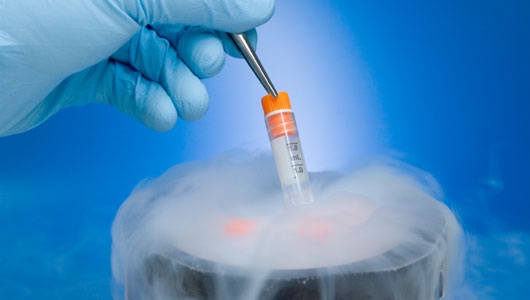
The doctor had retrieved 38 good eggs, of which 31 are fertilized. Over the next week, 16 of our embryonic children die and are discarded. Thirteen are cryogenically frozen, mostly two to a vial. Two fresh embryos are transferred to my uterus.

Yes, the cost is high for what we’re doing, both financially and physically. But it will be worth it, I tell myself. Because surely at least one of these embryos will give us our heart’s desire–a beautiful child of our own.

Justifying Our Choices

My journey into in vitro fertilization (IVF) actually began in the 1980s, when my mother used donor sperm and intrauterine insemination to conceive me and my twin sister. When we were 12, we discovered that the man we thought was our father was not. I was disturbed that we were created by my mother and a stranger, and have always felt as if only part of me was “real.”

Fast-forward to my own marriage in 2004. We wanted children right away, but a year of trying had resulted in no pregnancy. I was diagnosed with polycystic ovarian syndrome, an endocrine disorder that inhibits regular ovulation.

Doctors put me on the same ovulation-stimulating medication my mother had used to conceive me–Clomid. Four unsuccessful cycles later, we moved on to artificial insemination, though we did at least use my husband’s sperm. Still no baby.

In desperation, we graduated to the expensive and complex process of IVF, where my eggs and my husband’s sperm would be taken out of our bodies, joined in a petri dish, and the resulting embryos would be inserted into my uterus.

Even before we started down the IVF road, there was a voice inside of us whispering that it was wrong. But that voice was drowned out by louder, more persistent voices, like the doctors’ who said we had little to no chance to conceive without it. Friends and family, too, supported anything that would end the suffering of our infertility.

Then there was my own desire for a child, shouting down the doubts and assuring me that God would want me to be happy and that, as a woman, I deserved a child. And really, how could science that helps create life be a bad thing?

So we signed the contract and started the IVF process. To prepare, I took hormone injections and pills to stimulate my ovaries for egg retrieval. Though most eggs were fertilized simply by exposing them to sperm, some needed sperm forcibly injected into them with a needle.

These newly formed, microscopic human beings were then graded for quality and we were encouraged to discard “low-grade” embryos that had little chance of survival. But because we couldn’t fully stifle our doubts about the wrongness of IVF, we insisted that all our viable embryos be preserved.

Suffering and Loss

After the first transfer in July 2008, we were thrilled to discover that we were pregnant with twins, due the following April. But at 21 weeks gestation, our twins–Madi and Isaiah–were born prematurely and only lived for one hour each. During those brief, heartbreaking few hours, we held them, bathed them, dressed them, and baptized them, holding onto their tiny, fragile bodies as long as we could.

For the next year, I floated numbly through life. I believed the twins’ death was God punishing me for my past sins. My husband remained silent. Through it all, my heart was torn about the route we’d taken, as well as the fact that we still had 13 frozen children whose lives were on hold.

Eventually we felt ready to try IVF again. In October 2009, our only singly vialed embryo, Jeremiah, was thawed and transferred to my womb. We did not get pregnant.

In February 2010, we did another transfer. The embryologist came into the room beforehand and said that “one expanded and one did not.” We knew then that our son, Luke, had survived thawing, but that our daughter, Lucilla, had died and been discarded. In the end, Luke died, too, and we did not get pregnant.

Three months later, we thawed another vial and both Elijah and Ezekiel survived. The situation was complicated, however, because the death of the twins at 21 weeks had shown I had an incompetent cervix. This made carrying even one baby risky. We decided to transfer only one of the boys, because I would likely lose both if they developed properly after being transferred to the womb. Elijah was transferred and we were ecstatic when he was born in 2011.

His brother, Ezekiel, didn’t make it. But he was so, so resilient; he was initially frozen, thawed, refrozen, and re-thawed, yet survived to be transferred in January 2012. We did not get pregnant. Three months later, Olivia didn’t survive the thaw, but we were able to transfer Isaac.

A Spiritual Awakening

While waiting to see if I was pregnant with Isaac, I went on my first spiritual retreat. I went skeptical and defensive; I wasn’t going to share what I was going through with anyone. But God gave me a “spiritual spanking.” The poignant lyrics to a song caused me to break down crying and I experienced an intense spiritual awakening. That night, I went to reconciliation for the first time in years.

I had yet to own my sinfulness, however, because in my mind, I was still denying the truth—that I had killed my children through the violent and undignified process of IVF. By the end of the retreat, however, grace had finally washed away my pride and I experienced a full and overwhelming gift of faith.

Overnight, my life went from being about what I wanted to being entirely about the love of God. Two days after I returned from the retreat, we discovered that Isaac had died, too, and I was not pregnant.

After seeing my transformation, my husband went on the same retreat in May. He had several profound spiritual experiences of his own, where he felt the Lord lift the guilt from his heart. God assured him that our deceased babies were safe and loved and would be waiting for us in heaven.

But faith didn’t solve the problem of what to do with our still-frozen children. We could leave them frozen, discard them, donate them to scientific research, or adopt them out. We felt all those options were disrespectful to the children and we feared they were offensive to God, too.

We’ve since learned that the Catholic Church hasn’t fully clarified what is the most morally prudent and loving route to take when dealing with frozen embryonic children and theologians are all over the map on the issue. Some say every child created deserves a chance at life and ought to be implanted, as we did; other theologians suggest embryonic babies should be baptized, thawed until they pass away, and then buried. Hopefully the Church will soon define the best course for frozen IVF children, but until then, couples in our situation can only seek counsel through their spiritual advisers and through the Holy Spirit, in prayer. See more

Twisted Mystic Neil Diamond in ‘Play Me’ | My Catholic Tube

OK, I know that when you first saw this dazzling pic of Neil in his technicolor dreamcoat, you were tempted to go and google the etymology of “cheese” or something; anything rather than consider that Neil Diamond might have something deep to say to you today.

Maybe you thought “Twisted Mystics” was about young hipsters, youth in angst, or mainstream rockers and rollers. Well it’s time to broaden them horizons!

I was first introduced to Neil as a young lad, through the big, bulky “Jazz Singer” soundtrack my mother owned on an 8 track tape. Those tapes were awesome and could double as coasters, or a hammer if you were desperate and really needed to hang that painting.

Anyhoo, back to Neil. Let’s take the following words and set them into the mouths of lovers… of a husband and wife. This is what we do here at Twisted Mystics; we transpose. We find the theme and set it to a theological melody. We take a rambling branch and graft it to the Divine Vine from which all branches break forth.

She was morning

And I was night time

I one day woke up

To find her lying

Beside my bed

I softly said

“Come take me”

For I’ve been lonely

In need of someone

As though I’d done

Someone wrong somewhere

but I don’t know where

Come lately

You are the sun

I am the moon

You are the words

I am the tune

Play me

Ah the Cosmic Dance of masculine and feminine! “She was morning… and I was night time.” It’s common knowledge that men and women are different. Common knowledge but commonly misunderstood, or seen as some kind of obstacle (“the battle of the sexes”). Today, there also appears to be a great effort to level the playing field…. to asexualize our sexuality and invite people to “pick” which one they want, as if from scratch. But if we scratch below the surface, we discover an extremely damaging agenda here.

In the olden days (before Neil Diamond) people used to conform themselves to reality. This is a very sane thing to do. Today we are insane. We try to conform reality unto us. Rather than discover in our creation as male and female something of the mystery of God’s image and likeness, we determine that we will make ourselves after our own image and likeness. The problem with this is, aside from a cosmic arrogance, we don’t have a clue as to who we are.

“When we lose sight of the Creator, the creature vanishes,” so spoke Vatican Council II.

Our origins, revealed in Genesis, tell us so much about what masculinity is and what femininity is, if we could but sit still and listen. The mythic elements (not myths) in Genesis speak of man being formed from the earth, with Spirit (God’s ruah in Hebrew, breath) whispered into us. Is this why men seem to be more independent, detached, more comfortable being alone, distant at times? But in all our land-locked travels, we long to return to the heart.

READ MORE via Twisted Mystic Neil Diamond in ‘Play Me’ | My Catholic Tube.

Bill Donaghy

Bill Donaghy is a teacher, lay evangelist, and certified Theology of the Body speaker.

Visit his website for more: www.missionmoment.org.

Beauty Will Save the World: From the Mouth of an Idiot to the Pen of a Pope – Crisis Magazine.

via Beauty Will Save the World: From the Mouth of an Idiot to the Pen of a Pope – Crisis Magazine.

By R. Jared Staudt

A popular quote we often hear but find hard to understand is “beauty will save the world.” How will beauty save the world? The line comes from Dostoevsky’s novel, The Idiot, attributed to the main character, Prince Myskin. The prince, an epileptic Russian nobleman, serves as a Christ-like figure, who stands apart for his innocence and even naiveté. Out of the mouth of this idiot comes a clearer vision of beauty and reality than those around him, his clarity heightened even in the midst of his sickness.

The saving power of beauty in the prince’s life could not overcome his sickness, but nonetheless illumined his vision: “What matter though it be only disease, an abnormal tension of the brain, if when I recall and analyze the moment, it seems to have been one of harmony and beauty in the highest degree—an instant of deepest sensation, overflowing with unbounded joy and rapture, ecstatic devotion, and completest life?” In the midst of his suffering, he glimpsed, though in a paradoxical manner, the heart of reality.

Are the prince’s words on beauty the words of a mad idiot or of a prophet?

In Solzhenitsyn’s Noble lecture, he notes that after dismissing the quote for years, he realized that “Dostoevsky’s remark, ‘Beauty will save the world,’ was not a careless phrase but a prophecy. After all he was granted to see much, a man of fantastic illumination. And in that case art, literature might really be able to help the world today?”

If that is not enough, Pope John Paul II quoted the line in his Letter to Artists, under the heading “The Saving Power of Beauty”:

People of today and tomorrow need this enthusiasm [of wonder] if they are to meet and master the crucial challenges which stand before us. Thanks to this enthusiasm, humanity, every time it loses its way, will be able to lift itself up and set out again on the right path. In this sense it has been said with profound insight that “beauty will save the world” (§16).

Can the words of an idiot set the tone for our response to the modern world? In a mad world, maybe only the idiot is sane. It seems we can and even must trust him, now that the words of an idiot have become the words of a Pope!

Upon reading Pope Francis’s first encyclical, Lumen Fidei, I was struck most of all by its literary quality. The encyclical does not offer much theological innovation, but is remarkable for its engagement of culture: classical, medieval, and above all contemporary. It seems to follow Dostoevsky’s vision for the power of beauty. In our world that has largely rejected the ability of reason to know the truth and the moral order toward the good, is it a privileged moment for beauty? The encyclical seems to point to this reality, using literature and art to underscore its points.

Pope Benedict XVI, the primary drafter of Lumen Fidei, emphasized the absolutely essential role of beauty in human life in his “Meeting with Artists.” Guess who he turned to for support?

Dostoevsky’s words that I am about to quote are bold and paradoxical, but they invite reflection. He says this: “Man can live without science, he can live without bread, but without beauty he could no longer live, because there would no longer be anything to do to the world. The whole secret is here, the whole of history is here” (quoting from the novel, Demons).

Is it not clear that we are missing this key element of human life? And if we are, what does this mean for the life of faith?

Lumen Fidei does not explicitly draw out the significance of beauty for the light of the faith. Rather, it is demonstrated by the style of the encyclical itself. Once again, Dostoevsky makes a crucial appearance:

In Dostoevsky’s The Idiot, Prince Myskin sees a painting by Hans Holbein the Younger depicting Christ dead in the tomb and says: “Looking at that painting might cause one to lose his faith.” The painting is a gruesome portrayal of the destructive effects of death on Christ’s body. Yet it is precisely in contemplating Jesus’ death that faith grows stronger and receives a dazzling light; then it is revealed as faith in Christ’s steadfast love for us, a love capable of embracing death to bring us salvation. This love, which did not recoil before death in order to show its depth, is something I can believe in; Christ’s total self-gift overcomes every suspicion and enables me to entrust myself to him completely (§16).

This quote is significant in relation to Dostoevsky’s vision of beauty for a number of reasons. Like “beauty will save the world,” it comes from The Idiot and refers to Prince Myskin. Second, it points to a central theme of the novel, the struggle with beauty, physically and spiritually, in the midst of suffering. Third, this struggle and tension between physical and spiritual beauty becomes a central motif in the engagement of modern culture. In the midst of sickness, how can one perceive beauty clearly? Beauty should be a path to truth, and thus faith, but the modern world itself is disfigured and trapped in darkness. It has a kind of spiritual epilepsy, an internal, maddening sickness, which, unlike for Myskin, impairs the perception of true beauty.

Looking back to Benedict’s vision, we can see how beauty itself is luminous. The light of beauty is meant to illuminate the path toward the light of faith. In Benedict’s “Meeting with Artists,” we see both the darkness of the modern eclipse of beauty and true beauty’s ability to lead to sight:

Too often, though, the beauty that is thrust upon us is illusory and deceitful, superficial and blinding, leaving the onlooker dazed; instead of bringing him out of himself and opening him up to horizons of true freedom as it draws him aloft, it imprisons him within himself and further enslaves him, depriving him of hope and joy…. Authentic beauty, however, unlocks the yearning of the human heart, the profound desire to know, to love, to go towards the Other, to reach for the Beyond. If we acknowledge that beauty touches us intimately, that it wounds us, that it opens our eyes, then we rediscover the joy of seeing, of being able to grasp the profound meaning of our existence.

READ MORE: via Beauty Will Save the World: From the Mouth of an Idiot to the Pen of a Pope – Crisis Magazine.
