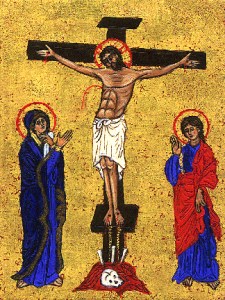
Lenten Reading Plan – Day 24 – Mar 24

crucificionicon12Day24 Church Fathers Lenten Reading Plan 3/24/09

St. Athanasius: Life of Anthony: 31-40

Day 24 Lite Version

St. Athanasius: Life of Anthony: 26-33

Compilation of Lenten readings

Printer-Friendly Version of Outline: Church Fathers Lenten Reading Plan PDF

Educators Fail – Lawmakers Fail – Journalists Fail – False Compassion Fails!

We have important moral and ethical problems to face in America and in the world.  In order to make educated decisions, people need to be educated.  Our present culture seems determined to keep the people, young and old, in the dark as to the life that lives and moves and has its being within a mother’s womb.

National Geographic will take you inside the womb, so that you can watch the reality.  While Planned Parenthood, funded by U.S. dollars, enters into the most personal and profound decisions women can make, offers less than the reality.  For the woman making a life changing decision, a decision that will impact, for better or worse, how she thinks and feels about herself and others,especially her own child, Planned Parenthood obscures the facts in favor of  its own agenda.  Planned Parenthood will, for instance, turn the monitor away from the pregnant mother during a sonogram procedure.  Why trouble the client with the fact within the womb of their client, an actual picture of the truth, the infant/fetus growing  within them.  Why is that? Could it be that seeing is believing and believing can effect a decision to abort, when such a decision would effect the financial bottom line of this booming mega-business?

Our schools are no better.  Values-free education is of  no value when it comes to living a moral, ethical human life.  Giving teenagers less than science, and telling them less than the actuality of  pregnancy and person-hood is to fail them.  We propagandize them, when we pretend they will not be effected by decisions that society makes for them in lieu of  the education that can with present technology show them, in flesh and blood, not only the life in the womb, but abortion as it really is.

When the young teenager is aborted of the baby she carries within her, she sees it and feels it, and then has to live with it.  What teacher, lawmaker, journalist or councilor has prepared her for this reality, rather than failed her  in the name of compassion and/or convenience?  False compassion leaves scars too deep to be helped by a brochure hastily given before dismissing the girl to make way for their next act of “mercy?”

The education needed for today’s moral and ethical decisions goes beyond the facts of pregnancy to the heavy lifting science touching on  embryonic stem cell research.  Here journalistic misinformation and purposeful skewing of the facts muddy the waters. Archbishop Charles J. Chaput spoke of  “The Evil of Embryo Destruction – In embryonic stem cell research, end does not justify the means.”

Commenting on journalistic integrity Chaput responses to the Denver Post:

In the debate over federal funding of embryonic stem cell research, some of the massive media coverage has been fair, accurate and thorough, but much of it — too much of it — has fallen short of reasonable journalistic standards.

By far the most troubling piece I’ve seen was the editorial, “Zealotry vs. science,” published by the Denver Post….. in this case, the Post used bombast and misleading information to argue its support for federally funded embryonic stem cell research in a way reminiscent of a not-very-bright bully.”

Ed Morrisey talks about the issue here with more from Archbishop Chaput

Lenten Reading Plan – Day 23 – Mar 23

crucificionicon12Day23 Church Fathers Lenten Reading Plan 3/23/09

St. Athanasius: Life of Anthony: 21-30

Day 23 Lite Version

St. Athanasius: Life of Anthony: 17-25

Compilation of Lenten readings

Printer-Friendly Version of Outline: Church Fathers Lenten Reading Plan PDF

The Whole Truth – Make it Plain, Brother!

You don’t usually get to hear a Lutheran congregation holler an, “Amen” or “Preach it, Brother. ” Today was no  different, but the minister seemed to want one.  I was visiting with the Lutherans and the minister confessed that the one time he could remember that someone called out, “Amen, Brother”, it caught him so by surprise that it totally threw him into confusion.  Now, however, Jesus was talking plain in the Gospel and the minister felt he could use a reminder from the pews to, “Make it plain; make it plain!” He was preaching John 3:16, “the Bible in a nutshell.”

The evening before, I heard a priest of the Roman Catholic Church preach it.  He truly kept it simple.  He said,
“Life is short. Hell is for Eternity. Think about it!”  He sat down.  That was it! Talk about nutshells.

My Lutheran friend said a bit more, before remembering his injunction to himself, “Make it plain!”  The plain fact was that “God so loved the world that he gave his only Son, so that everyone who believes in him might not perish but might have eternal life.” The minister said that the love He bore us was not the stuff of  “warm fuzzies” but “agape”, that  to die for love that willing died for all mankind; sparing not a drop of blood, or leaving a breathe unspent.

The sermon in my head reminded me, Jesus plainly and emphatically proclaimed that verse, now made famous by placards at football games and  verse17: “For God did not send his Son into the world to condemn the world, but that the world might be saved through him.” However, not many people finish the message.  Jesus’ “make it plain” message,  was also recorded by John in chapter 3:18-19.

No “warm fuzzies” here, either, only the uncomfortable part of the Truth, John 3:18-19.

“Whoever believes in him will not be condemned, but whoever does not believe has already been condemned, because he has not believed in the name of the only Son of God.  And this is the verdict, that the light came into the world, but people preferred darkness to light, because their works were evil.”

Jesus spoke the whole Truth and so should we because:  “Life is short. Hell is for Eternity. Think about it!”

Chaput Moving Catholics To Action

What’s in a word?  Archbishop Chaput will tell you:

Archbishop of Denver Charles J. Chaput delivered a speech on Saturday reflecting on the significance of the November 2008 election. Warning that media “narratives” should not obscure truth, he blamed the indifference and complacency of many U.S. Catholics for the country’s failures on abortion, poverty and immigration issues.

He also advised Catholics to “master the language of popular culture” and to refuse to be afraid, saying “fear is the disease of our age.”

American Consumer Culture – A Powerful Narcotic

I’m hoping that our present crisis will encourage  thinking.

Archbishop Charles J. Chaput speaking in Toronto:

Obviously, I’ll be speaking tonight as an American, a Catholic and a bishop — though not necessarily in that order. Some of what I say may not be useful to a Canadian audience, especially those who aren’t Catholic. But I do believe that the heart of the Catholic political vocation remains the same for every believer in every country. The details of our political life change from nation to nation. But the mission of public Christian discipleship remains the same, because we all share the same baptism.

I’ve learned from experience, though, that Henry Ford was right when he said that “Two percent of the people think; three percent think they think, and 95 percent would rather die than think.

Ford had a pretty dark view of humanity, which I don’t share. Most of the people I meet as a pastor have the brains and the talent to live very fulfilling lives. But Ford was right in one unintended way: American consumer culture is a very powerful narcotic. Moral reasoning can be hard, and TV is a great painkiller. This has political implications. Real freedom demands an ability to think, and a great deal of modern life — not just in the United States, but all over the developed world — seems deliberately designed to discourage that. So talking about God and Caesar, even if it wakes up just one Christian mind in an audience, is always worth the effort.

I think the message of “Render Unto Caesar” can be condensed into a few basic points.Here’s the first point. For many years, studies have shown that Americans have a very poor sense of history. That’s very dangerous, because as Thucydides and Machiavelli and Thomas Jefferson have all said, history matters. It matters because the past shapes the present, and the present shapes the future. If Catholics don’t know history, and especially their own history as Catholics, then somebody else — and usually somebody not very friendly — will create their history for them.

Let me put it another way. A man with amnesia has no future and no present because he can’t remember his past. The past is a man’s anchor in experience and reality. Without it, he may as well be floating in space. In like manner, if we Catholics don’t remember and defend our religious history as a believing people, nobody else will, and then we won’t have a future because we won’t have a past. If we don’t know how the Church worked with or struggled against political rulers in the past, then we can’t think clearly about the relations between Church and state today.

Even more recent Chaput from the Anchoress