America Historically Is Not A Secular State

More Archbishop Charles J. Chaput from his speech in Toronto.  He is speaking as an American, a Catholic and a bishop about “Rending Unto Casaer”

Excerpt from speech:

Here’s the second point, and it’s a place where the Canadian and American experiences may diverge. America is not a secular state. As historian Paul Johnson once said, America was “born Protestant.” It has uniquely and deeply religious roots. Obviously it has no established Church, and it has non-sectarian public institutions. It also has plenty of room for both believers and non-believers. But the United States was never intended to be a “secular” country in the radical modern sense. Nearly all the Founders were either Christian or at least religion-friendly. And all of our public institutions and all of our ideas about the human person are based in a religiously shaped vocabulary. So if we cut God out of our public life, we also cut the foundation out from under our national ideals.

Here’s the third point. We need to be very forceful in clarifying what the words in our political vocabulary really mean. Words are important because they shape our thinking, and our thinking drives our actions. When we subvert the meaning of words like “the common good” or “conscience” or “community” or “family,” we undermine the language that sustains our thinking about the law. Dishonest language leads to dishonest debate and bad laws.

Here’s an example. We need to remember that tolerance is not a Christian virtue. Charity, justice, mercy, prudence, honesty — these are Christian virtues. And obviously, in a diverse community, tolerance is an important working principle. But it’s never an end itself. In fact, tolerating grave evil within a society is itself a form of serious evil. Likewise, democratic pluralism does not mean that Catholics should be quiet in public about serious moral issues because of some misguided sense of good manners. A healthy democracy requires vigorous moral debate to survive. Real pluralism demands that people of strong beliefs will advance their convictions in the public square — peacefully, legally and respectfully, but energetically and without embarrassment. Anything less is bad citizenship and a form of theft from the public conversation.

Here’s the fourth point. When Jesus tells the Pharisees and Herodians in the Gospel of Matthew (22:21) to “render unto the Caesar the things that are Caesar’s and to God the things that are God’s,” he sets the framework for how we should think about religion and the state even today. Caesar does have rights. We owe civil authority our respect and appropriate obedience. But that obedience is limited by what belongs to God. Caesar is not God. Only God is God, and the state is subordinate and accountable to God for its treatment of human persons, all of whom were created by God. Our job as believers is to figure out what things belong to Caesar, and what things belong to God — and then put those things in right order in our own lives, and in our relations with others.

So having said all this, what does a book like “Render Unto Caesar” mean, in practice, for each of us as individual Catholics? It means that we each have a duty to study and grow in our faith, guided by the teaching of the Church. It also means that we have a duty to be politically engaged. Why? Because politics is the exercise of power, and the use of power always has moral content and human consequences.

Even more recent Chaput from the Anchoress


American Consumer Culture – A Powerful Narcotic

I’m hoping that our present crisis will encourage  thinking.

Archbishop Charles J. Chaput speaking in Toronto:

Obviously, I’ll be speaking tonight as an American, a Catholic and a bishop — though not necessarily in that order. Some of what I say may not be useful to a Canadian audience, especially those who aren’t Catholic. But I do believe that the heart of the Catholic political vocation remains the same for every believer in every country. The details of our political life change from nation to nation. But the mission of public Christian discipleship remains the same, because we all share the same baptism.

I’ve learned from experience, though, that Henry Ford was right when he said that “Two percent of the people think; three percent think they think, and 95 percent would rather die than think.

Ford had a pretty dark view of humanity, which I don’t share. Most of the people I meet as a pastor have the brains and the talent to live very fulfilling lives. But Ford was right in one unintended way: American consumer culture is a very powerful narcotic. Moral reasoning can be hard, and TV is a great painkiller. This has political implications. Real freedom demands an ability to think, and a great deal of modern life — not just in the United States, but all over the developed world — seems deliberately designed to discourage that. So talking about God and Caesar, even if it wakes up just one Christian mind in an audience, is always worth the effort.

I think the message of “Render Unto Caesar” can be condensed into a few basic points.Here’s the first point. For many years, studies have shown that Americans have a very poor sense of history. That’s very dangerous, because as Thucydides and Machiavelli and Thomas Jefferson have all said, history matters. It matters because the past shapes the present, and the present shapes the future. If Catholics don’t know history, and especially their own history as Catholics, then somebody else — and usually somebody not very friendly — will create their history for them.

Let me put it another way. A man with amnesia has no future and no present because he can’t remember his past. The past is a man’s anchor in experience and reality. Without it, he may as well be floating in space. In like manner, if we Catholics don’t remember and defend our religious history as a believing people, nobody else will, and then we won’t have a future because we won’t have a past. If we don’t know how the Church worked with or struggled against political rulers in the past, then we can’t think clearly about the relations between Church and state today.

Even more recent Chaput from the Anchoress

Somewhere Nebraska – Somewhere Springtime

Getting to Nebraska, we passed a lot of dry, brown land.  Colorful Colorado was a grayish tan.  But here and there bright green fields told you things were ready to burst out at the first fall of rain.

On the surface things can look bleak.  Beneath the surface, they are ready to pop. What I have to keep reminding myself is that life is thriving on planet Earth.  God is in His heaven and that makes all the difference.  Somewhere the bountiful and beautiful is happening, maybe not here, perhaps in distant, hidden places, but it’s happening and its abundant!  While, there are dry spells, and dormant periods with things that go wrong, other things are so very right.

Change, for all my discomfort, is as ordinary as air. I know that if it’s happening, at very least, God is permitting it. He always has a plan and I don’t understand simply because He hasn’t run it past me.  That does make even the present dilemma a work in progress – mysterious design and all that.

In the world or in the Church, it all hangs together.  We are waiting for rain.  John Paul II spoke of a Springtime for the Church and I believe that now, in this very dark hour, we are actually living it.  Beneath the materialism and relativism and all those other ism’s, is a harvest in the making. It waits, perhaps, on laborers and a rain of prayer, but it none-the- less is hanging fire.

I find my Springtime in my prayer.  Whether my experience of prayer is dry or consoling, doesn’t matter, anymore.  I am praying.  Day by day, I’m just doing it…. and I’m not alone in this.  Whoever is waiting on change can actually move the hands of God in His heaven, turning the dreary grey of their waiting, into a poppin’ Springtime.

For me, it’s hidden but it’s happening.  For each of us, it’s a “Just do it!” thing, hanging on a decision.  What you don’t see, none-the-less, is building beneath the surface of our day to day.  Days past, present and to come, days for forgiving, repenting, and imploring; all prayer, all the time. Springtime will come without me, but don’t want to miss it.  I want to run through the fields and feel it in my soul.

Joan of Arc – A Prayer For Lent

Asked at her trial if she was in God’s grace:

“If I am not, may God put me there, and if I am, may God so keep me! I should be the saddest creature in the world if I knew I was not in His grace.”

Mark Twain said of her:

“She was truthful when lying was the common speech of men; she was honest when honest was become a lost virtue; she was a keeper of promises when the keeping of a promise was expected of no one; … she was full of pity when a merciless cruelty was the rule; she was steadfast when stability was unknown, and honorable in an age which had forgotten what honor was; she was a rock of convictions in a time when men believed in nothing and scoffed at all things; she was unfailingly true in an age that was false to the core; … she was of a dauntless courage when hope and courage had perished in the hearts of her nation…”

Lenten Reading Plan – Day 22 – Mar 21

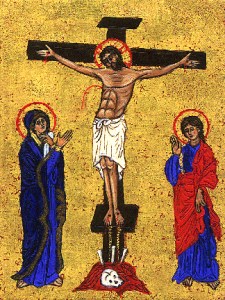
crucificionicon12Day22 Church Fathers Lenten Reading Plan 3/21/09

St. Athanasius: Life of Anthony: 11-20

Day 22 Lite Version

St. Athanasius: Life of Anthony: 10-16

Compilation of Lenten readings

Printer-Friendly Version of Outline: Church Fathers Lenten Reading Plan PDF

“Borne by Angels to the Bosom of God” – St. Therese of Lisieux

From The Story of a Soul, The Autobiography of St. Therese of Lisieux:

“Dear Mother, I have still to tell you what I understand by the  “sweet odour of the Beloved.” As Our Lord is now in Heaven, I can only follow Him by the footprints He has left–footprints full of life, full of fragrance. I have only to open the Holy Gospels and at once I breathe the perfume of Jesus, and then I know which way to run; and it is not to the first place, but to the last, that I hasten. I leave the Pharisee to go up, and full of confidence I repeat the humble prayer of the Publican. Above all I follow Magdalen, for the amazing, rather I should say, the loving audacity, that delights the Heart of Jesus, has cast its spell upon mine. It is not because I have been preserved from mortal sin that I lift up my heart to God in trust and love. I feel that even had I on my conscience every crime one could commit, I should lose nothing of my confidence: my heart broken with sorrow, I would throw myself into the Arms of my Saviour. I know that He loves the Prodigal Son, I have heard His words to St. Mary Magdalen, to the woman taken in adultery, and to the woman of Samaria. No one could frighten me, for I know what to believe concerning His Mercy and His Love. And I know that all that multitude of sins would disappear in an instant, even as a drop of water cast into a flaming furnace.

It is told in the Lives of the Fathers of the Desert how one of them converted a public sinner, whose evil deeds were the scandal of the whole country. This wicked woman, touched by grace, followed the Saint into the desert, there to perform rigorous penance. But on the first night of the journey, before even reaching the place of her retirement, the bonds that bound her to earth were broken by the vehemence of her loving sorrow. The holy man, at the same instant, saw her soul borne by Angels to the Bosom of God.”