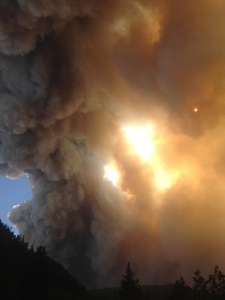
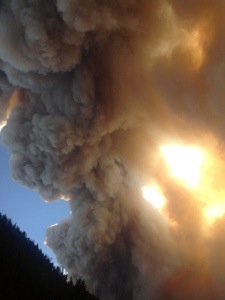
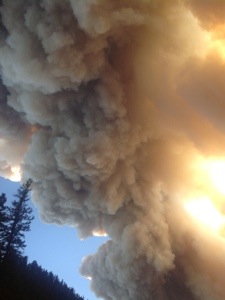
Fire Jumps the Ridge

We packed up our trailer and got out of Dodge. The fire jumped the ridge and the mandatory evacuation went into full gear. We had to stop in South Fork to finish rigging her out. Sky is ablaze and everyone’s saying their prayers. God bless.

20130620-202627.jpg

20130620-202541.jpg

20130620-201506.jpg

20130620-201617.jpg

Nature has a way of being beautiful under the worst conditions:20130620-165711.jpg

20130620-165726.jpg

20130620-165744.jpg

20130620-165804.jpg

Believe

O Man, believe
That the Virgin did conceive
Her God and mine
And happily thine.

©2013 Joann Nelander

On false spiritual peace

From the teachings of Saint Dorotheus, abbot
On false spiritual peace

The man who finds fault with himself accepts all things cheerfully – misfortune, loss, disgrace, dishonor and any other kind of adversity. He believes that he is deserving of all these things and nothing can disturb him. No one could be more at peace than this man.

But perhaps you will offer me this objection: “Suppose my brother injures me, and on examining myself I find that I have not given him any cause. Why should I blame myself?”

Certainly if someone examines himself carefully and with fear of God, he will never find himself completely innocent. He will see that he has given some provocation by an action, a word or by his manner. If he does find that he is not guilty in any of these ways, certainly he must have injured that brother somehow at some other time. Or perhaps he has been a source of annoyance to some other brother. For this reason he deserves to endure the injury because of many other sins that he has committed on other occasions.

Someone else asks why he should accuse himself when he was sitting peacefully and quietly when a brother came upon him with an unkind or insulting word. He cannot tolerate it, and so he thinks that his anger is justified. If that brother had not approached him and said those words and upset him, he never would have sinned.

This kind of thinking is surely ridiculous and has no rational basis. For the fact that he has said anything at all in this situation breaks the cover on the passionate anger within him, which is all the more exposed by his excessive anxiety. If he wished, he would do penance. He has become like a clean, shiny grain of wheat that, when broken, is full of dirt inside.

The man who thinks that he is quiet and peaceful has within him a passion that he does not see. A brother comes up, utters some unkind word and immediately all the venom and mire that lie hidden within him are spewed out. If he wishes mercy, he must do penance, purify himself and strive to become perfect. He will see that he should have returned thanks to his brother instead of returning the injury, because his brother has proven to be an occasion of profit to him. It will not be long before he will no longer be bothered by these temptations. The more perfect he grows, the less these temptations will affect him. For the more the soul advances, the stronger and more powerful it becomes in bearing the difficulties that it meets.

The man who finds fault with himself accepts all things cheerfully – misfortune, loss, disgrace, dishonor and any other kind of adversity. He believes that he is deserving of all these things and nothing can disturb him. No one could be more at peace than this man.

But perhaps you will offer me this objection: “Suppose my brother injures me, and on examining myself I find that I have not given him any cause. Why should I blame myself?”

Certainly if someone examines himself carefully and with fear of God, he will never find himself completely innocent. He will see that he has given some provocation by an action, a word or by his manner. If he does find that he is not guilty in any of these ways, certainly he must have injured that brother somehow at some other time. Or perhaps he has been a source of annoyance to some other brother. For this reason he deserves to endure the injury because of many other sins that he has committed on other occasions.

Someone else asks why he should accuse himself when he was sitting peacefully and quietly when a brother came upon him with an unkind or insulting word. He cannot tolerate it, and so he thinks that his anger is justified. If that brother had not approached him and said those words and upset him, he never would have sinned.

This kind of thinking is surely ridiculous and has no rational basis. For the fact that he has said anything at all in this situation breaks the cover on the passionate anger within him, which is all the more exposed by his excessive anxiety. If he wished, he would do penance. He has become like a clean, shiny grain of wheat that, when broken, is full of dirt inside.

The man who thinks that he is quiet and peaceful has within him a passion that he does not see. A brother comes up, utters some unkind word and immediately all the venom and mire that lie hidden within him are spewed out. If he wishes mercy, he must do penance, purify himself and strive to become perfect. He will see that he should have returned thanks to his brother instead of returning the injury, because his brother has proven to be an occasion of profit to him. It will not be long before he will no longer be bothered by these temptations. The more perfect he grows, the less these temptations will affect him. For the more the soul advances, the stronger and more powerful it becomes in bearing the difficulties that it meets.

the incarnation of the Word and the sacrament of the eucharist

From the treatise On the Trinity by Saint Hilary, bishop
The unity of the faithful in God through the incarnation of the Word and the sacrament of the eucharist

We believe that the Word became flesh and that we receive his flesh in the Lord’s Supper. How then can we fail to believe that he really dwells within us? When he became man, he actually clothed himself in our flesh, uniting it to himself for ever. In the sacrament of his body he actually gives us his own flesh, which he has united to his divinity. This is why we are all one, because the Father is in Christ, and Christ is in us. He is in us through his flesh and we are in him. With him we form a unity which is in God.

The manner of our indwelling in him through the sacrament of his body and blood is evident from the Lord’s own words: This world will see me no longer but you shall see me. Because I live you shall live also, for I am in my Father, you are in me, and I am in you. If it had been a question of mere unity of will, why should he have given us this explanation of the steps by which it is achieved? He is in the Father by reason of his divine nature, we are in him by reason of his human birth, and he is in us through the mystery of the sacraments. This, surely, is what he wished us to believe; this is how he wanted us to understand the perfect unity that is achieved through our Mediator, who lives in the Father while we live in him, and who, while living in the Father, lives also in us. This is how we attain to unity with the Father. Christ is in very truth in the Father by his eternal generation; we are in very truth in Christ, and he likewise is in us.

Christ himself bore witness to the reality of his unity when he said: He who eats my flesh and drinks my blood lives in me and I in him. No one will be in Christ unless Christ himself has been in him; Christ will take to himself only the flesh of those who have received his flesh.

He had already explained the mystery of this perfect unity when he said: As the living Father sent me and I draw life from the Father, so he who eats my flesh will draw life from me. We draw life from his flesh just as he draws life from the Father. Such comparisons aid our understanding, since we can grasp a point more easily when we have an analogy. And the point is that Christ is the wellspring of our life. Since we who are in the flesh have Christ dwelling in us through his flesh, we shall draw life from him in the same way he draws life from the Father.

A Sacrifice to God and His Priest

From a sermon by Saint Peter Chrysologus, bishop
Each of us is called to be both a sacrifice to God and his priestdivineoffice.org

I appeal to you by the mercy of God. This appeal is made by Paul, or rather, it is made by God through Paul, because of God’s desire to be loved rather than feared, to be a father rather than a Lord. God appeals to us in his mercy to avoid having to punish us in his severity.

Listen to the Lord’s appeal: In me, I want you to see your own body, your members, your heart, your bones, your blood. You may fear what is divine, but why not love what is human? You may run away from me as the Lord, but why not run to me as your father? Perhaps you are filled with shame for causing my bitter passion. Do not be afraid. This cross inflicts a mortal injury, not on me, but on death. These nails no longer pain me, but only deepen your love for me. I do not cry out because of these wounds, but through them I draw you into my heart. My body was stretched on the cross as a symbol, not of how much I suffered, but of my all-embracing love. I count it no loss to shed my blood: it is the price I have paid for your ransom. Come, then, return to me and learn to know me as your father, who repays good for evil, love for injury, and boundless charity for piercing wounds.

Listen now to what the Apostle urges us to do. I appeal to you, he says, to present your bodies as a living sacrifice. By this exhortation of his, Paul has raised all men to priestly status.

How marvellous is the priesthood of the Christian, for he is both the victim that is offered on his own behalf, and the priest who makes the offering. He does not need to go beyond himself to seek what he is to immolate to God: with himself and in himself he brings the sacrifice he is to offer God for himself. The victim remains and the priest remains, always one and the same. Immolated, the victim still lives: the priest who immolates cannot kill. Truly it is an amazing sacrifice in which a body is offered without being slain and blood is offered without being shed.

The Apostle says: I appeal to you by the mercy of God to present your bodies as a living sacrifice. Brethren, this sacrifice follows the pattern of Christ’s sacrifice by which he gave his body as a living immolation for the life of the world. He really made his body a living sacrifice, because, though slain, he continues to live. In such a victim death receives its ransom, but the victim remains alive. Death itself suffers the punishment. This is why death for the martyrs is actually a birth, and their end a beginning. Their execution is the door to life, and those who were thought to have been blotted out from the earth shine brilliantly in heaven.

Paul says: I appeal to you by the mercy of God to present your bodies as a sacrifice, living and holy. The prophet said the same thing: Sacrifice and offering you did not desire, but you have prepared a body for me. Each of us is called to be both a sacrifice to God and his priest. Do not forfeit what divine authority confers on you. Put on the garment of holiness, gird yourself with the belt of chastity. Let Christ be your helmet, let the cross on your forehead be your unfailing protection. Your breastplate should be the knowledge of God that he himself has given you. Keep burning continually the sweet smelling incense of prayer. Take up the sword of the Spirit. Let your heart be an altar. Then, with full confidence in God, present your body for sacrifice. God desires not death, but faith; God thirsts not for blood, but for self-surrender; God is appeased not by slaughter, but by the offering of your free will.

Riding the Wind

He rides the Wind in power and right,
Born of Eternal Light.
All goodness follow in His train,
Like comet tails, falling stars,
That fire my night.

Here light upon my soul and nest,
As spirit bird, find place of rest,
Spreading feathered wing
As shelter, and friend,
To Godly bless.

Stirring, fan the embers of my love,
To blaze anew in fire from above
Transforming dust and dross,
To forge one who walks
Amongst the flame, O Holy Dove.

©2013 Joann Nelander