Jesus Takes Revenge

In today’s reading, Jer 11:18-20, Jeremiah wants revenge.  He sees himself as a trusting lamb led to slaughter; although he knew he was in danger, he did not realize that his enemies were hatching plots against him.  Jeremiah wants vengeance and he wants to be there to witness it in spades.

“Let me witness the vengeance you take on them, for to you I have entrusted my cause!”

In today’s homily, Monsignor, asks, “How does Jesus take vengeance on His enemies?”  Monsignor answers,  “He dies for them!”

Christians imitate Jesus. Scripture directs us in dealing with our enemies:

“You have heard that it was said, ‘You shall love your neighbor and hate your enemy.’
But I say to you, love your enemies, and pray for those who persecute you,” Matthew 5:43-44
If your enemy be hungry, give him food to eat, if he be thirsty, give him to drink;
For live coals you will heap on his head, and the LORD will vindicate you. Proverbs 25:22

We are all in the same boat, we are all sinners, enemies of  God, so long as we persist in Sin.  Jesus, for his part, dies for us. He has prayed for his enemies, “Father, forgive them!” He has fed them, “Take and eat!” He has satisfied their thirst, “Take and drink!”

Jesus appeals to the heart of men.  We can turn away.  We can experience, with Jesus, rejection.  In all these circumstances Jesus says pray.  That prayer is powerful, whether it is prayer of praise, worship, thanksgiving, adoration, or petition.

If we could only see it with Heaven’s eyes as John did as he records in the Book of Revelation:

“And when he had taken the book, the four living creatures and the four and twenty elders fell down before the Lamb, having each one a harp, and golden bowls full of incense, which are the prayers of the saints.” Rev 5:8

“These are the ones who have survived the time of great distress; they have washed their robes and made them white in the blood of the Lamb. For this reason they stand before God’s throne and worship him day and night in his temple.”Rev 7:14

What is this washing of their robes, if it is not the Sacrament of Reconciliation.  If it were referring to Baptism, they would not be doing the washing, whereas in Reconciliation we have an active role.

Jesus wants what’s best for each of us. He wants enemies (sinners) to feel the hot coals of  prayer heaped upon them.  To see ourselves as Jesus sees us when we sin can be distressing. Such a moment, though wrenching, is a moment of grace. Jesus desires a response of the heart that sends the sick and sorrowful to show themselves to the priest for healing and forgiveness.

Our revenge is to be like our Christ. Our revenge is to die to ourselves with our Christ.  Our revenge is to see the enemies of Christ come forth from the confessional with tears of joy and thanksgiving in all humility; no longer enemies but as brothers.

What will it take? Prayer.  All are called, moment by moment, while we live, “Repent and believe the Good News!” Mk 1:15
Morning – A Time for Prayer

Psalm 143: 8-11

In the morning let me know your love
For I put my trust in you.
Make me know the way I should walk;
To you I lift up my soul.

Rescue me, Lord, from my enemies;
I have fled to you for refuge.
Teach me to do your will
For you, O Lord, are my God.
Let your good spirit guide me
In ways that are level and smooth.

For you name’s sake, Lord, save my like;
In your justice save my soul from distress.

The Whole Truth – Make it Plain, Brother!

You don’t usually get to hear a Lutheran congregation holler an, “Amen” or “Preach it, Brother. ” Today was no  different, but the minister seemed to want one.  I was visiting with the Lutherans and the minister confessed that the one time he could remember that someone called out, “Amen, Brother”, it caught him so by surprise that it totally threw him into confusion.  Now, however, Jesus was talking plain in the Gospel and the minister felt he could use a reminder from the pews to, “Make it plain; make it plain!” He was preaching John 3:16, “the Bible in a nutshell.”

The evening before, I heard a priest of the Roman Catholic Church preach it.  He truly kept it simple.  He said,
“Life is short. Hell is for Eternity. Think about it!”  He sat down.  That was it! Talk about nutshells.

My Lutheran friend said a bit more, before remembering his injunction to himself, “Make it plain!”  The plain fact was that “God so loved the world that he gave his only Son, so that everyone who believes in him might not perish but might have eternal life.” The minister said that the love He bore us was not the stuff of  “warm fuzzies” but “agape”, that  to die for love that willing died for all mankind; sparing not a drop of blood, or leaving a breathe unspent.

The sermon in my head reminded me, Jesus plainly and emphatically proclaimed that verse, now made famous by placards at football games and  verse17: “For God did not send his Son into the world to condemn the world, but that the world might be saved through him.” However, not many people finish the message.  Jesus’ “make it plain” message,  was also recorded by John in chapter 3:18-19.

No “warm fuzzies” here, either, only the uncomfortable part of the Truth, John 3:18-19.

“Whoever believes in him will not be condemned, but whoever does not believe has already been condemned, because he has not believed in the name of the only Son of God.  And this is the verdict, that the light came into the world, but people preferred darkness to light, because their works were evil.”

Jesus spoke the whole Truth and so should we because:  “Life is short. Hell is for Eternity. Think about it!”

“Borne by Angels to the Bosom of God” – St. Therese of Lisieux

From The Story of a Soul, The Autobiography of St. Therese of Lisieux:

“Dear Mother, I have still to tell you what I understand by the  “sweet odour of the Beloved.” As Our Lord is now in Heaven, I can only follow Him by the footprints He has left–footprints full of life, full of fragrance. I have only to open the Holy Gospels and at once I breathe the perfume of Jesus, and then I know which way to run; and it is not to the first place, but to the last, that I hasten. I leave the Pharisee to go up, and full of confidence I repeat the humble prayer of the Publican. Above all I follow Magdalen, for the amazing, rather I should say, the loving audacity, that delights the Heart of Jesus, has cast its spell upon mine. It is not because I have been preserved from mortal sin that I lift up my heart to God in trust and love. I feel that even had I on my conscience every crime one could commit, I should lose nothing of my confidence: my heart broken with sorrow, I would throw myself into the Arms of my Saviour. I know that He loves the Prodigal Son, I have heard His words to St. Mary Magdalen, to the woman taken in adultery, and to the woman of Samaria. No one could frighten me, for I know what to believe concerning His Mercy and His Love. And I know that all that multitude of sins would disappear in an instant, even as a drop of water cast into a flaming furnace.

It is told in the Lives of the Fathers of the Desert how one of them converted a public sinner, whose evil deeds were the scandal of the whole country. This wicked woman, touched by grace, followed the Saint into the desert, there to perform rigorous penance. But on the first night of the journey, before even reaching the place of her retirement, the bonds that bound her to earth were broken by the vehemence of her loving sorrow. The holy man, at the same instant, saw her soul borne by Angels to the Bosom of God.”

St. Joseph’s Day – The Man Behind the Day

Who is St. Joseph? Scripture says little about this man and yet we honor him with titles such as Patron of the Universal Church and Patron of a peaceful death.  The Bible simply calls him “just.” Mt 1;19  All we actually need to know is that Joseph is God’s choice.

God knows a man as he actually is in his heart of hearts from the moment God calls him by name, before he is conceived in the womb, until God calls him to Himself. Every moment, every thought, every movement of the heart, nothing hidden or forgotten, and, knowing all, God chose Joseph. He chose Joseph for Mary. He chose Joseph for Jesus. Knowing Joseph’s heart, God called Joseph “just” which means right with God.

Our generation places little value on “just.” It has no glitz. Give us “world renowned” and “phenomenally successful.” “Just” is just so unimpressive. If “just” were only as common as it sounds.

Today’s celebration will go unnoticed and unreported by the world, but the courts of Heaven ring with Joseph’s name this day. Jesus and Mary embrace him, sharing with saints and angels, their memories of his obedience to the Will of God, his humility, his protective care, his kindness and the sacrificial love that reigned over their home and their life together. Who remembers St. Joseph?  God remembers St. Joseph.  The God-Man remembers St. Joseph, and called him “Abba”, no doubt.

The Glory and the Tragedy of the Church

“In Lent, we grasp our humanity” says Fr. Jeffrey Whorton.  That we need a reminder at all amazes me. I am in awe of the fact that I, a soft bodied creature, am still alive, after more than half a century, in this universe of whirling planets, exploding stars and expanding space. Extrapolating from today’s Gospel, Fr. Whorton points to the hedges God places around us for our survival. In Jesus’ parable, He tells of  a landowner who planted a vineyard and put a hedge around it (Matthew 31: 23)

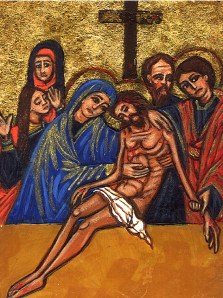
iconpieta9

Pieta Icon

In nature and the Cosmos, Earth is protected by natural laws which set the rhythms of the tides, confine the seas to their basins and keep the very air we breath from drifting off into space. While in the spiritual  life, God’s children also have a hedge.  Before we knew the Grace of God, we were given the Law of God.  God’s people were to live not unfettered by human respect but by a Golden Rule which revealed the freedom of morally.  When the Grace of God arrived incarnated in Jesus Christ, love went beyond this Law to lead us to lay down our lives for one another, the supernature wed to the natural.  Lent points to our failure in this respect. It is precisely here, that we find another hedge protecting us from the Accuser and self-condemnation by an Incarnated Mercy, Whose love and forgiveness knows no bounds.

In daily life, the teachings of the Church provide a hedge against a license and an immorality that would favor the animal side of our natures.  Without the hedge of revealed Truth and instruction, we are deprived, and left to our sinfulness, which is more an inhuman nature.   Our humanity was glorified by Christ once Jesus put it on as a mantle clothing His Divinity.  However, it still needs the individual response of our consent and cooperation. Now, we are hedged by the very flesh of our Savior, and called to be truly human as revealed by Christ.

According to Fr.Whorton, “The glory and the tragedy of the Church is that the Church is on display.”  In our world of brute forces and competing philosophies and errors, we are called to shine like stars (Phil.2: 15), like sparks among the stubble (Wisdom 3:7). Fr. Whorton asks, as does Lent, itself, “Am I displaying the glory or the tragedy?”