Pope John Paul II Quotes- Speaking on "Mary Co-Redemptrix"

"To Our Lady—the Coredemptrix—St. Charles turned with singularly revealing accents. Commenting on the loss of the twelve-year-old Jesus in the Temple, he reconstructed the interior dialogue that could have run between the Mother and the Son, and he added, “You will endure much greater sorrows, O blessed Mother, and you will continue to live; but life will be for you a thousand times more bitter than death. You will see your innocent Son handed over into the hands of sinners . . . You will see him brutally crucified between thieves; you will see his holy side pierced by the cruel thrust of a lance; finally, you will see the blood that you gave him spilling. And nevertheless you will not be able to die!” (From the homily delivered in the Cathedral of Milan the Sunday after the Epiphany, 1584). (3)

From address on World Youth Day:

March 11, 1985

"At the Angelus hour on this Palm Sunday, which the Liturgy calls also the Sunday of the Lord’s Passion, our thoughts run to Mary, immersed in the mystery of an immeasurable sorrow.

Mary accompanied her divine Son in the most discreet concealment, pondering everything in the depths of her heart. On Calvary, at the foot of the Cross, in the vastness and in the depth of her maternal sacrifice, she had John, the youngest Apostle, beside her . . . .

May Mary our Protectress, the Co-redemptrix, to whom we offer our prayer with great outpouring, make our desire generously correspond to the desire of the Redeemer."

Guayaquil, Ecuador, on January 31, 1985:

"Mary goes before us and accompanies us. The silent journey that begins with her Immaculate Conception and passes through the “yes” of Nazareth, which makes her the Mother of God, finds on Calvary a particularly important moment. There also, accepting and assisting at the sacrifice of her son, Mary is the dawn of Redemption; . . . Crucified spiritually with her crucified son (cf. Gal. 2:20), she contemplated with heroic love the death of her God, she “lovingly consented to the immolation of this Victim which she herself had brought forth” (Lumen Gentium, 58) . . . .

In fact, at Calvary she united herself with the sacrifice of her Son that led to the foundation of the Church; her maternal heart shared to the very depths the will of Christ “to gather into one all the dispersed children of God” (Jn. 11:52). Having suffered for the Church, Mary deserved to become the Mother of all the disciples of her Son, the Mother of their unity . . . .
The Gospels do not tell us of an appearance of the risen Christ to Mary. Nevertheless, as she was in a special way close to the Cross of her Son, she also had to have a privileged experience of his Resurrection. In fact, Mary’s role as Coredemptrix did not cease with the glorification of her Son. "

Speaking of  St. Bridget of Sweden (October 6, 1991), the John Paul stated:

"Birgitta looked to Mary as her model and support in the various moments of her life. She spoke energetically about the divine privilege of Mary’s Immaculate Conception. She contemplated her astonishing mission as Mother of the Saviour. She invoked her as the Immaculate Conception, Our Lady of Sorrows, and Coredemptrix, exalting Mary’s singular role in the history of salvation and the life of the Christian people"

Papal audience of May 29, 1996

"Dearest brothers and sisters, in the month of May we raise our eyes to Mary, the woman who was associated in a unique way in the work of mankind’s reconciliation with God. According to the Father’s plan, Christ was to accomplish this work through his sacrifice. However, a woman would be associated with him, the Immaculate Virgin who is thus placed before our eyes as the highest model of cooperation in the work of salvation. . . .

The “Yes” of the Annunciation constituted not only the acceptance of the offered motherhood, but signified above all Mary’s commitment to service of the mystery of the Redemption. Redemption was the work of her Son; Mary was associated with it on a subordinate level. Nevertheless, her participation was real and demanding. Giving her consent to the angel’s message, Mary agreed to collaborate in the whole work of mankind’s reconciliation with God, just as her Son would accomplish it.

Feast of Corpus Christi, June 5, 1983

"Born of the Virgin to be a pure, holy and immaculate oblation, Christ offered on the Cross the one perfect Sacrifice which every Mass, in an unbloody manner, renews and makes present. In that one Sacrifice, Mary, the first redeemed, the Mother of the Church, had an active part. She stood near the Crucified, suffering deeply with her Firstborn; with a motherly heart she associated herself with his Sacrifice; with love she consented to his immolation (cf. Lumen Gentium, 58; Marialis Cultus, 20): she offered him and she offered herself to the Father. Every Eucharist is a memorial of that Sacrifice and that Passover that restored life to the world; every Mass puts us in intimate communion with her, the Mother, whose sacrifice “becomes present” just as the Sacrifice of her Son “becomes present” at the words of consecration of the bread and wine pronounced by the priest. "

Great Jubilee Year

"Daughter of Abraham in faith as well as in the flesh, Mary personally shared in this experience. Like Abraham, she too accepted the sacrifice of her Son, but while the actual sacrifice of Isaac was not demanded of Abraham, Christ drank the cup of suffering to the last drop. Mary personally took part in her Son’s trial, believing and hoping at the foot of the Cross (cf. Jn. 19:25).

This was the epilogue of a long wait. Having been taught to meditate on the prophetic texts, Mary foresaw what awaited her and in praising the mercy of God, faithful to his people from generation to generation, she gave her own consent to his plan of salvation; in particular, she said her “yes” to the central event of this plan, the sacrifice of that Child whom she bore in her womb. Like Abraham, she accepted the sacrifice of her Son."

Read Dr. Mark Miravalle here for more

the Salvation and Sanctification of Souls

From the Letters of Maximilian Mary Kolbe

<blockquote><strong>Apostolic zeal for the salvation and sanctification of souls</strong>

The burning zeal for God’s glory that motivates you fills my heart with joy. It is sad for us to see in our own time that indifferentism in its many forms is spreading like an epidemic not only among the laity but also among religious. But God is worthy of glory beyond measure, and therefore it is of absolute and supreme importance to seek that glory with all the power of our feeble resources. Since we are mere creatures we can never return to him all that is his due. The most resplendent manifestation of God’s glory is the salvation of souls, whom Christ redeemed by shedding his blood. To work for the salvation and sanctification of as many souls as possible, therefore, is the preeminent purpose of the apostolic life. Let me, then, say a few words that may show the way toward achieving God’s glory and the sanctification of many souls.

God, who is all-knowing and all-wise, knows best what we should do to increase his glory. Through his representatives on earth he continually reveals his will to us; thus it is obedience and obedience alone that is the sure sign to us of the divine will. A superior may, it is true, make a mistake; but it is impossible for us to be mistaken in obeying a superior’s command. The only exception to this rule is the case of a superior commanding something that in even the slightest way would contravene God’s law. Such a superior would not be conveying God’s will.

God alone is infinitely wise, holy, merciful, our Lord, Creator, and Father; he is beginning and end, wisdom and power and love; he is all. Everything other than God has value to the degree that it is referred to him, the maker of all and our own redeemer, the final end of all things. It is he who, declaring his adorable will to us through his representatives on earth, draws us to himself and whose plan is to draw others to himself through us and to join us all to himself in an ever deepening love.

Look, then, at the high dignity that by God’s mercy belongs to our state in life. Obedience raises us beyond the limits of our littleness and puts us in harmony with God’s will. In boundless wisdom and care, his will guides us to act rightly. Holding fast to that will, which no creature can thwart, we are filled with unsurpassable strength.

Obedience is the one and the only way of wisdom and prudence for us to offer glory to God. If there were another, Christ would certainly have shown it to us by word and example. Scripture, however, summed up his entire life at Nazareth in the words: He was subject to them; Scripture set obedience as the theme of the rest of his life, repeatedly declaring that he came into the world to do his Father’s will. Let us love our loving Father with all our hearts. Let our obedience increase that love, above all when it requires us to surrender our own will. Jesus Christ crucified is our sublime guide toward growth in God’s love.

We will learn this lesson more quickly through the Immaculate Virgin, whom God has made the dispenser of his mercy. It is beyond all doubt that Mary’s will represents to us the will of God himself. By dedicating ourselves to her we become in her hands instruments of God’s mercy even as she was such an instrument in God’s hands. We should let ourselves be guided and led by Mary and rest quiet and secure in her hands. She will watch out for us, provide for us, answer our needs of body and spirit; she will dissolve all our difficulties and worries.</blockquote>

Message from Holy Love

Holy Love
March 20, 2012
Public
Blessed Mother says:  "Praise be to Jesus."
"I am about to advise you concerning the resolution of the last Marian Dogma, and why Heaven asks for prayers toward this end.  Once this Handmaid of the Lord is officially accepted as Mediatrix, Co-Redemptrix and Advocate, the Spirit of Peace will pass over the world.  Every heart will be pervaded by Truth.  It is at that moment in time souls will need to decide either for Truth or against it."
"Truth will be as a winnowing fan separating the chaff from the grain.  All error will be exposed to the Light.  Enmity will transform to friendship."
"I tell you these things now so that no one can say they did not recognize what was taking place.  No one can discount the events as they occur and lose the opportunity for conversion of heart."
"Pay attention!"

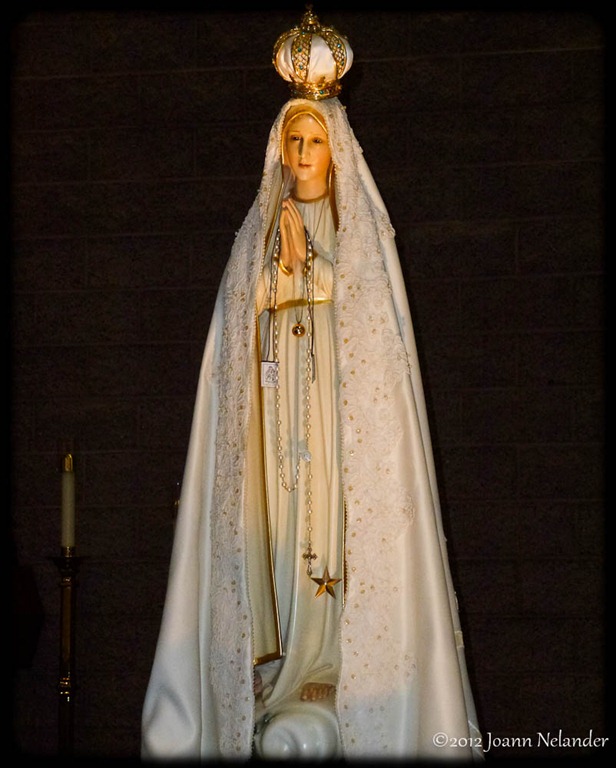
On a Visit of the Pilgrim Virgin


untitled (6 of 8)
Pick me up, dear Mother
Your visit means so much to me.
O, how I need a mother.

I gaze at your image,
And you engrave it on my heart.
The beating of my heart,
Reminds me of my mortality,
And how you were
At a moment in time, Mary,
The young virgin with Child, in Nazareth,
Living life on earth
As I do now.

O,  how I wish to live
In your purity
And simplicity of heart.

Here I am
At your feet in supplication,
Pleading peace,
That I might live
In the spirit of Shalom.

Here is my kiss.
Remember me,
As You gaze on your Son.
Engrave my name upon His heart,
As  your fire of love blazes
In His presence.
I am love,
Awaiting the embrace of Love.


Copyright Joann Nelander 2012

Scriptural Rosary Podcast

Joyful Scriptural Mysteries - Podcast

joyful

Luminous Scriptural Mysteries - Podcast

Luminous

Sorrowful Scriptural Mysteries Pt.1

sorrowful pt 1

sorrowful pt 2

Sorrowful Scriptural Mysteries Pt. 2

Glorious Scriptural Mysteries - Podcast

Glorious

by Joann Nelander

Our Lady of Lourdes – “I AM THE IMMACULATE CONCEPTION”

Narrated by Mariola Paini


In 1858 the virgin Mary Immaculate appeared to Bernadette Soubirous near Lourdes in France within the cave of Massabielle. Through this humble girl, Mary called sinners to conversion and enkindled within the Church a great zeal for prayer and charity, especially service to the sick and poor. From a letter by Saint Marie Bernadette Soubirous, virgin (Ep. ad P. Gondrand, a 1861: cf. A. Ravier, Les écrits de sainte Bernadette, Paris 1961, pp. 53-59) The lady spoke to me I had gone down one day with two other girls to the bank of the river Gave when suddenly I heard a kind of rustling sound. I turned my head toward the field by the side of the river but the trees seemed quite still and the noise was evidently not from them. Then I looked up and caught sight of the cave where I saw a lady wearing a lovely white dress with a bright belt. On top of each of her feet was a pale yellow rose, the same color as her rosary beads. At this I rubbed my eyes, thinking I was seeing things, and I put my hands into the fold of my dress where my rosary was. I wanted to make the sign of the cross but for the life of me I couldn’t manage it and my hand just fell down. Then the lady made the sign of the cross herself and at the second attempt I managed to do the same, though my hands were trembling. Then I began to say the rosary while the lady let her beads slip through her fingers, without moving her lips. When I stopped saying the Hail Mary, she immediately vanished. I asked my two companions if they had noticed anything, but they said no. Of course they wanted to know what I was doing and I told them that I had seen a lady wearing a nice white dress, though I didn’t know who she was. I told them not to say anything about it, and they said I was silly to have anything to do with it. I said they were wrong and I came back next Sunday, feeling myself drawn to the place…. The third time I went the lady spoke to me and asked me to come every day for fifteen days. I said I would and then she said that she wanted me to tell the priests to build a chapel there. She also told me to drink from the stream. I went to the Gave, the only stream I could see. Then she made me realize she was not speaking of the Gave and she indicated a little trickle of water close-by. When I got to it I could only find a few drops, mostly mud. I cupped my hands to catch some liquid without success and then I started to scrape the ground. I managed to find a few drops of water but only at the fourth attempt was there a sufficient amount for any kind of drink. The lady then vanished and I went back home. I went back each day for fifteen days and each time, except one Monday and one Friday, the lady appeared and told me to look for a stream and wash in it and to see that the priests build a chapel there. I must also pray, she said, for the conversion of sinners. I asked her many times what she meant by that, but she only smiled. Finally with outstretched arms and eyes looking up to heaven she told me she was the Immaculate Conception. During the fifteen days she told me three secrets but I was not to speak about them to anyone and so far I have not. This letter from St. Bernadette (linked above) is from the Office of Readings for this day. I put this letter here because the language in which she speaks of Mary’s apparitions is that of a child. Dear Bernadette was young and poor when The Blessed Mother appeared to her. She aspired only a simple life, was not overly bright, and it would seem that she was incapable of greatness by this world’s standards. Yet, the Blessed Mother appeared to her, and spoke to her kindly and gave her gentle instructions. When Bernadette first saw Our Lady, she did not immediately identify her. She saw, rather, a beautiful woman. In fact, she did not presume to admit that the lady was the Blessed Mother until she was told by the lady herself. Mary called herself the Immaculate Conception, a true expression of beauty. Mary’s message to Bernadette was simple and caring, like that of a Mother. Bernadette, although not great, was a saint of blessings and virtue. Mary chose to appear to her and laid upon her shoulders the charge of sharing Mary with others. Bernadette did not live a very long life… but it was one of patient suffering and hope for the world to come. “I cannot promise to make you happy in this world, but in the next” was the promise of the Blessed Mother to her daughter. Bernadette trusted in this promise, with that childlike faith and obedience that were so exemplary in her visits with Mary. This is an example of how Mary is a mother to us. Her apparitions to her gentle daughter Bernadette brings us a message of prayer and healing. Each time that Mary has visited us, she has come with the same tender love and caring. Let us always remember how deeply Mary loves us, how intimate she is with Jesus, and seek to follow her Motherly guidance and receive her consolation.

A Letter of Saint Marie Bernadette Soubirou

God of mercy,
we celebrate the feast of Mary,
the sinless mother of God.
May her prayers help us
to rise above our human weakness.

We ask this through our Lord Jesus Christ, your Son,
who lives and reigns with you and the Holy Spirit,
one God, for ever and ever.

– Amen.